Speaker Design
SPLmeter dBm2 Review: 150 dB Car Audio SPL Meter
Published October 8, 2026
The SPLmeter dBm2 is a legacy high-SPL car-audio meter. This review checks its documented controls, 150 dB scale, tuning uses, limits, and alternatives.
The SPLmeter dBm2 is a legacy dedicated meter for measuring sound pressure in high-output car-audio systems. Surviving product photographs show a digital SPL readout, dedicated AVG and MAX controls, and a front scale marked through 150 dB. Historical car-audio users also used the dBm2 when comparing enclosure changes and test results. This review is based on surviving product evidence and published technical references rather than a hands-on test of a physical unit.
Verdict: The dBm2 is interesting because it was purpose-built for the old-school car-audio SPL scene and provides a much higher stated ceiling than ordinary sound-level meters of its era. Its strongest use today is controlled A/B tuning—repeat the same test after one change and compare the difference. Its biggest weakness is documentation: I could not verify a surviving manufacturer data sheet that establishes a formal accuracy, IEC class, frequency response, weighting network, or time-weighting specification. Treat it as a legacy measurement tool, not as a modern certified reference instrument.
What the SPLmeter dBm2 is
The product is branded splmeter.com and dbm-2 in surviving photographs. An archived product image shows the meter with a black enclosure, a numeric display, a scale marked 90, 110, 130 and 150 dB, and three front controls labeled PWR, AVG and MAX. A surviving owner's-manual image is also associated with the product. These visual details are useful evidence of the user interface, but they do not establish hidden electrical or acoustic specifications.
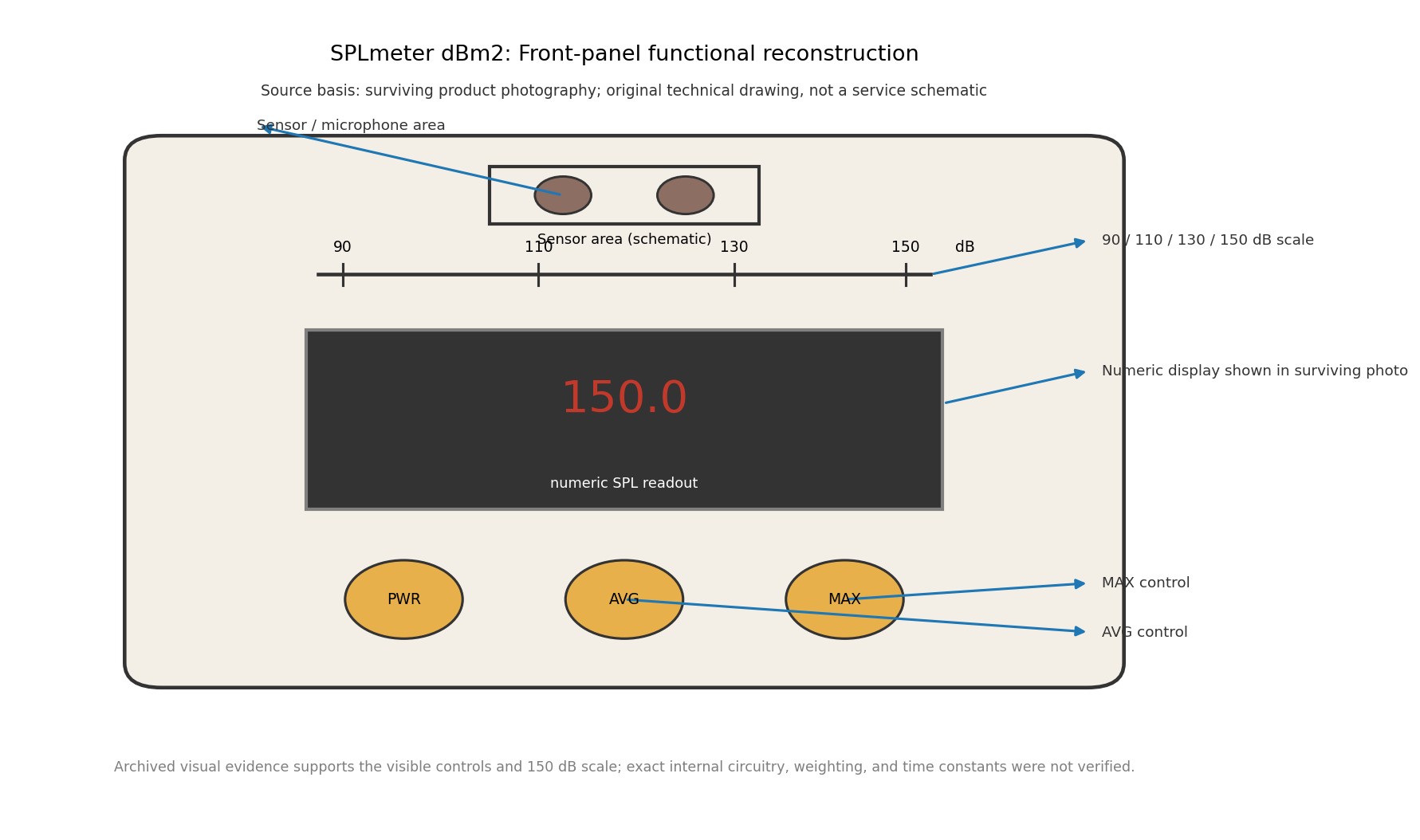
The model should also be understood as a sound-pressure measurement device, not as a conventional laboratory sound-level meter automatically certified to a particular standard. IEC 61672 defines Class 1 and Class 2 sound-level-meter performance categories and the associated measurement requirements, but I could not verify a surviving claim that the dBm2 conforms to either class.
Documented specifications and what is still unknown
| Item | Research finding |
|---|---|
| Model / branding | SPLmeter dBm2 / dbm-2; surviving product images show splmeter.com branding |
| Published or marketed maximum | 150 dB |
| Front-panel controls visible in surviving product images | PWR, AVG, MAX |
| Front scale visible in surviving product images | 90, 110, 130, 150 dB |
| Display evidence | Numeric digital readout; a surviving image shows 150.0 |
| Intended application | Automotive / car-audio SPL measurement |
| Formal accuracy specification | Not verified from reliable surviving manufacturer documentation |
| IEC 61672 class | Not verified |
| A/C/Z weighting | Not verified |
| Fast/slow or exact averaging time | Not verified |
| Frequency-response specification | Not verified |
| Current manufacturer support | Not verified; surviving web evidence is historical |
That incomplete specification record matters. Modern sound-level meters usually document their frequency weighting, time weighting, microphone or sensor characteristics, operating range and conformance testing. IEC 61672 explicitly treats these characteristics as part of the performance framework. With the dBm2, the surviving evidence is strongest for its intended car-audio application, its control layout, and its 150 dB scale—not for laboratory metrology.
What the 150 dB number means
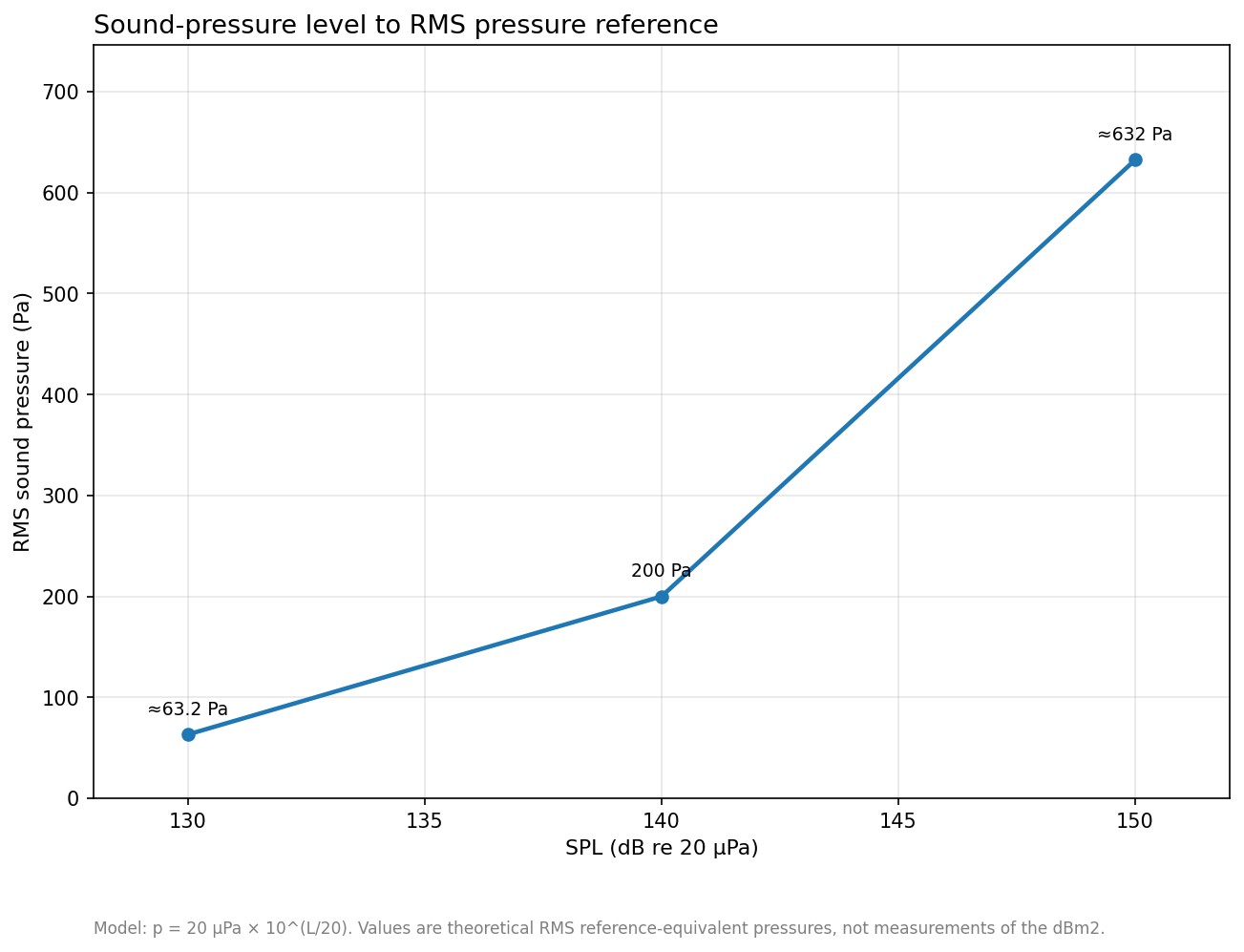
SPL is logarithmic. For sound pressure in air, the reference level is 20 µPa, and the basic relationship is Lp = 20 log10(p / p0). That means a 150 dB reading is not merely “a little louder” than 140 dB; it represents about 3.162 times the RMS pressure of a 140 dB level.
| SPL | Theoretical RMS pressure | Equivalent rounded value |
|---|---|---|
| 130 dB | 63.2 Pa | ≈0.63 kPa |
| 140 dB | 200.0 Pa | 2.00 kPa |
| 150 dB | 632.5 Pa | ≈6.32 kPa |
These pressure values are a calculation from the SPL definition, not measurements made with the dBm2. They are useful for understanding why extreme-SPL instruments require appropriate sensors and front-end design. NIOSH notes that many ordinary sound-level instruments clip at much lower levels, while specialized instruments can be designed for extreme acoustic impulses.
How the dBm2 is most useful in a car-audio system
Use it as a comparison instrument
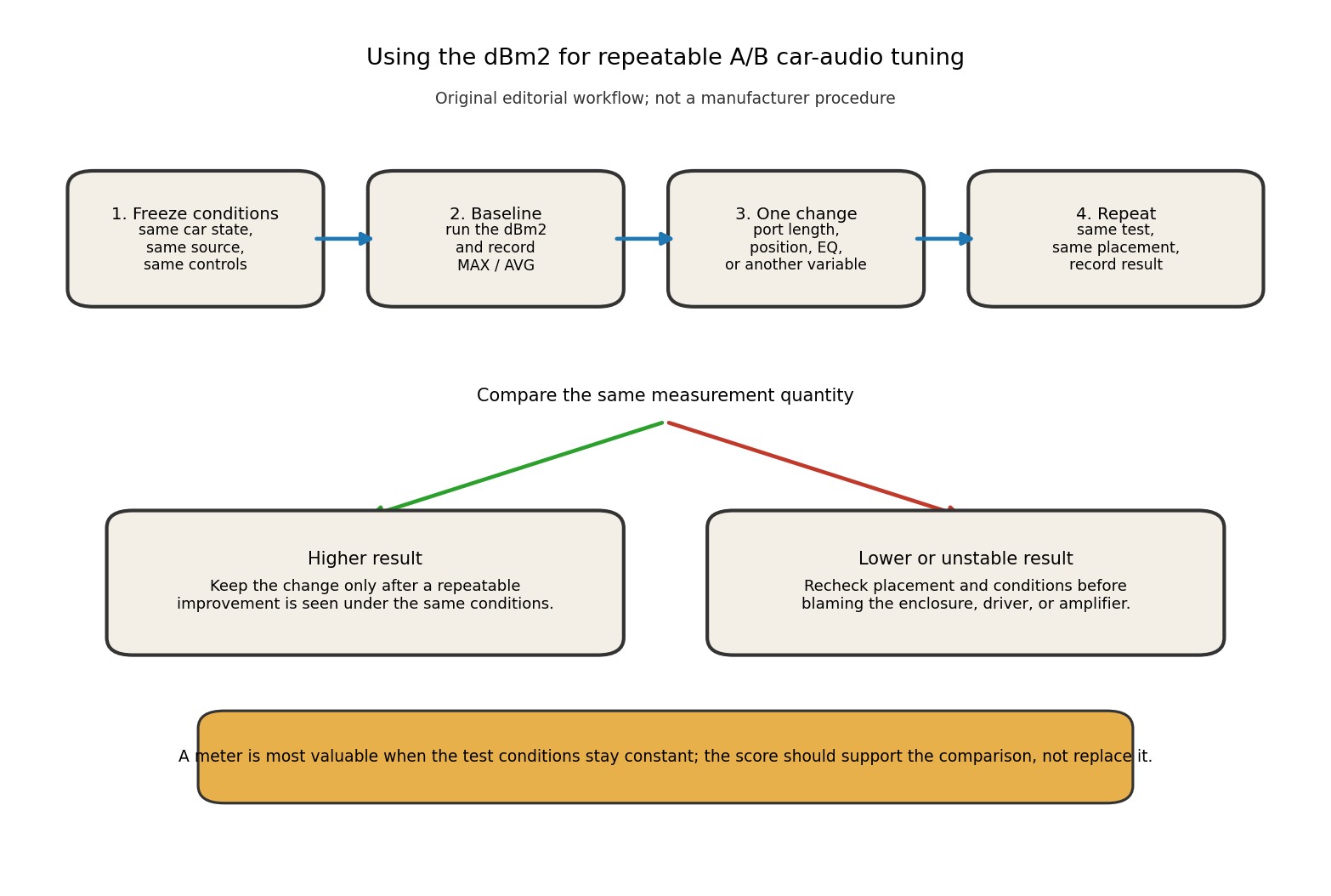
The best case for a legacy meter like the dBm2 is relative tuning. Suppose you shorten a port, move an enclosure, change a crossover point, or alter a test frequency. Run the dBm2 before the change, make exactly one change, and run it again under the same conditions. If the reading rises consistently, the change likely improved the measured SPL under that test condition.
This approach is stronger than arguing about whether one dBm2 reading is exactly the same as a Term-LAB score. Historical users have reported different offsets between the dBm2 and Term-LAB. One 2015 car-audio build report explicitly treated its dBm2 readings as useful for comparing two subwoofers while saying it did not regard the values as equivalent to Term-LAB scores.
Keep the test conditions fixed
Vehicle acoustics change the result. Cabin volume, doors and windows, enclosure location, subwoofer orientation, port placement and the vehicle's resonant behavior can all change the measured pressure. A meaningful A/B test therefore needs the same meter location, the same vehicle configuration, the same source signal and the same system settings.
AVG versus MAX: why both are useful
The front panel gives the operator separate AVG and MAX controls. The distinction is conceptually important even though the exact dBm2 algorithms are not documented in the surviving sources I could verify.
An average value is useful when a test signal or program material has level variation. A maximum value is useful when the objective is to find the highest observed SPL during a defined run. In either case, the measurement only becomes meaningful when the test window and conditions are kept the same.
Do not assume that “MAX” means the same thing as every other meter's peak measurement. IEC 61672 distinguishes different types of time-weighted and integrating measurements, so two instruments can legitimately process the same acoustic event differently.
A simple dB worked example
Because SPL is logarithmic, small displayed differences correspond to predictable pressure ratios:
| Change | Pressure ratio | Interpretation |
|---|---|---|
| 1 dB | 1.122× | ≈1.122× pressure |
| 3 dB | 1.413× | ≈1.413× pressure |
| 6 dB | 1.995× | ≈1.995× pressure |
| 10 dB | 3.162× | ≈3.162× pressure |
The calculation uses pressure ratio = 10^(ΔdB/20). For example, a 3 dB increase corresponds to about 1.413 times the RMS sound pressure. A 6 dB increase corresponds to almost exactly double the pressure. These are mathematical relationships, not statements about what a particular dBm2 will display in a specific car.
What historical users reported about accuracy
The surviving car-audio community record is mixed enough that accuracy claims should be treated carefully. In one 2009 discussion, users reported differences of about 1 dB between the dBm2 and a Term-LAB in a particular setup, while another post described a substantially larger difference in a different vehicle and context. A separate 2014 report said the meter was thought to be within roughly 3 dB of Term-LAB, again as a field expectation rather than a laboratory test.
Those reports support one practical conclusion: do not apply a universal correction factor to every dBm2. If you need absolute numbers that matter for formal competition scoring, use the measurement system specified by the competition or event. If you are tuning your own car, consistency from one controlled run to the next is often more valuable than pretending a legacy meter has a calibration certificate it does not have.
Calibration: what to do with a used dBm2
Historical users have also described an adjustment or calibration provision on the underside of the case. I could not verify an original manufacturer service document explaining the calibration reference, adjustment range, or required equipment, so I would not recommend turning the adjustment randomly.
A sound-level measurement system should be calibrated against a known acoustic reference when absolute accuracy matters. Term-PRO's technical guidance likewise describes calibration as a separate step before sound-pressure measurement. In a used dBm2, the safer approach is to establish whether the meter is internally stable first, then compare it against a known reference system under controlled conditions before deciding whether any correction is justified.
What to inspect before buying a used dBm2
- Display: verify that all digits and indicators are readable and stable.
- Controls: confirm that PWR, AVG and MAX respond reliably rather than intermittently.
- Sensor area: inspect the microphone or pressure-sensor housing for physical damage or contamination.
- Power lead: inspect the cable and connector for cuts, exposed conductors or intermittent contact. Do not power a damaged unit.
- Repeatability: run a steady test signal several times and see whether the reading behaves consistently.
- Cross-check: when possible, compare the dBm2 with a trusted reference meter in the same vehicle and position.
- Documentation: ask for the owner's manual, original accessories and any evidence of calibration history.
Safety: Extreme car-audio SPL can cause hearing damage. Do not remain in a high-SPL vehicle merely to watch the number climb, and do not improvise electrical repairs on the meter or its power cable while the system is energized. NIOSH notes that very high acoustic levels can exceed the measurement range of ordinary instruments as well as create serious exposure hazards.
How the dBm2 compares with current SPL tools
| Option | Position in the market | Published range / ceiling | Main capability | Important limitation |
|---|---|---|---|---|
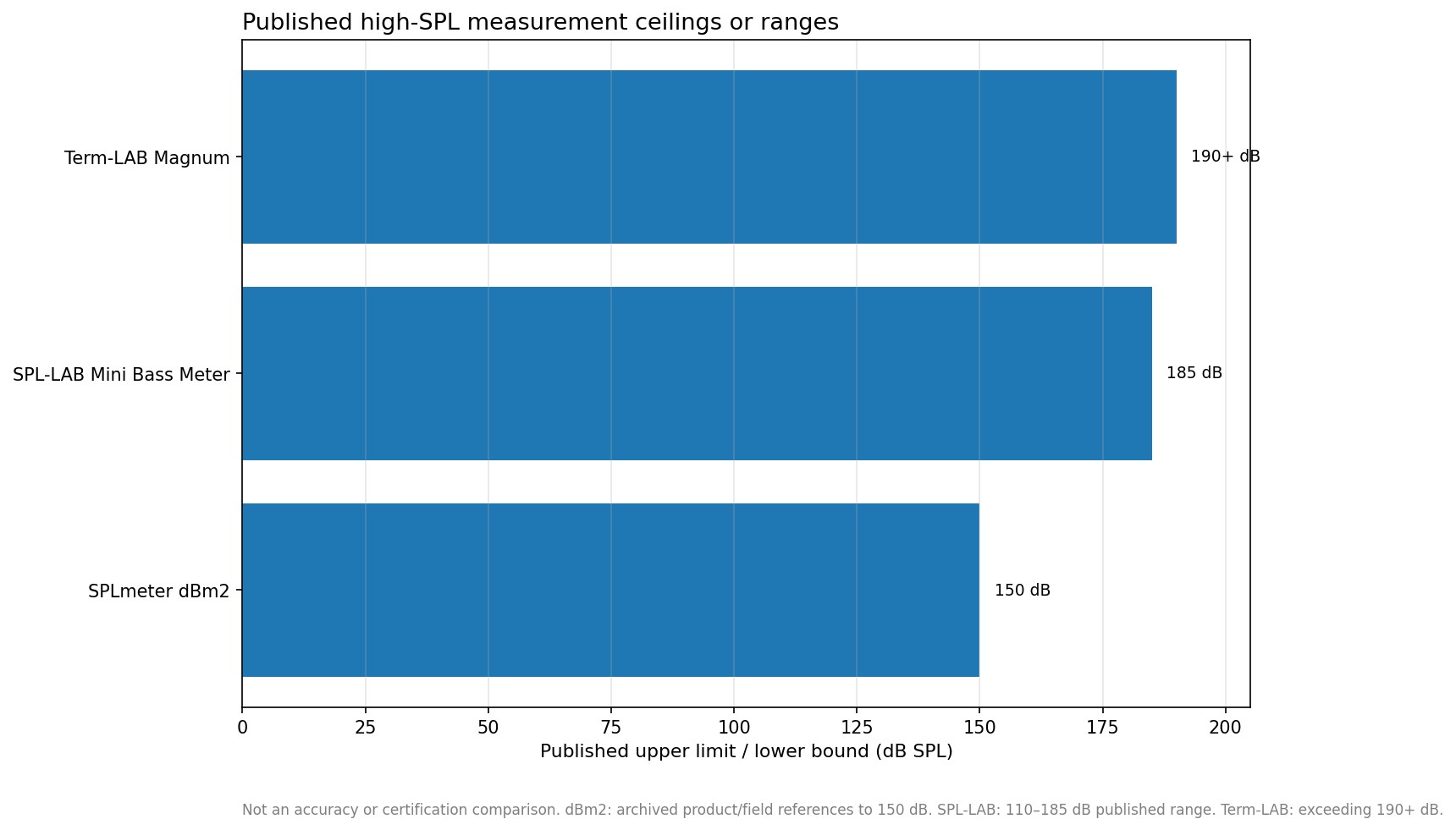
| SPLmeter dBm2 | Legacy dedicated automotive meter | 150 dB documented/marketed ceiling | Simple on-unit readout; AVG/MAX controls; historical tuning use | Manufacturer accuracy/class data not verified |
| SPL-LAB Mini Bass Meter | Current high-SPL bass meter | 110–185 dB; 10–120 Hz | SPL peak, AVG, voltage; 0.1 dB stated accuracy; USB/cigarette-lighter power | More specialized and current, but different sensor/platform |
| Term-LAB Magnum | Professional car-audio SPL platform | Exceeding 190+ dB | Digital pressure sensor, software analysis, optional power probes | Much more capability and complexity |
SPL-LAB's current Mini Bass Meter is documented at 110–185 dB over 10–120 Hz, with stated 0.1 dB measurement accuracy, 0.1 V voltage resolution, 1–2 Hz frequency indication, peak and average algorithms, and 5–20 V DC measurement capability.
Term-LAB's current Magnum platform is designed for high-SPL car audio and is published as measuring beyond 190+ dB. The manufacturer also offers software analysis, digital pressure sensors and optional electrical power measurements.
When a general-purpose sound-level meter is better
Not every speaker project needs 150 dB capability. For ordinary cabin noise, speaker-level balancing, environmental noise checks or lower-level troubleshooting, a conventional sound-level meter with a documented IEC 61672 class can provide better traceability than a legacy car-audio-specific meter. IEC 61672 specifies two performance categories and gives the test framework for time-weighted and integrating sound-level measurements.
The dBm2 becomes relevant when your actual measurement problem is extreme automotive SPL and you want a compact dedicated instrument rather than a workplace/environmental sound meter.
Common mistakes when using an SPL meter
- Comparing different meter types as though their numbers are identical: a displayed 145 dB on one instrument is not automatically the same measurement as 145 dB on another.
- Changing more than one variable: you then cannot identify which change caused the result.
- Moving the sensor between runs: placement changes the acoustic field and can hide small gains or losses.
- Changing the car state: door position, windows, HVAC settings, battery condition and other configuration changes can alter the result.
- Chasing a single peak without checking repeatability: a one-off number is weaker evidence than a repeatable improvement.
- Assuming the 150 dB scale is an accuracy guarantee: range and accuracy are different specifications.
Who should buy a dBm2 today?
The dBm2 makes sense for a collector, a period-correct SPL enthusiast, or a car-audio builder who wants an inexpensive legacy meter primarily for repeatable A/B comparisons. It is especially interesting when the unit is already available locally with a known working sensor and stable display.
It is not the first choice for someone who needs documented metrological performance, modern software, frequency analysis, official competition measurement, or a readily supported current product. In those cases, a current platform such as Term-LAB or SPL-LAB is easier to justify because the available technical documentation is substantially clearer.
Final verdict
The SPLmeter dBm2 is a real piece of old-school car-audio measurement hardware whose surviving evidence supports a 150 dB-oriented design, AVG and MAX controls, and a clear purpose: helping enthusiasts measure and tune very loud systems. Its historical use in enclosure and subwoofer comparisons is credible, and its simple interface is still attractive for that job.
The limitation is not that the concept is obsolete; it is that the documentation is incomplete. I could not verify a formal accuracy specification, IEC class, weighting network, frequency-response specification, or detailed calibration procedure from reliable surviving manufacturer documentation. That makes the dBm2 best treated as a repeatability-focused legacy tuning meter, not as a universal reference standard.
Sources and further reading
- eCoustics historical discussion of SPL meters and the dBm2
- eCoustics 2005 discussion naming the splmeter.com dBm-2
- Steve Meade Designs historical dBm2 A/B comparison example
- IEC 61672-1:2013 sound-level-meter specifications
- SPL-LAB Mini Bass Meter technical manual
- Term-LAB current SPL measurement systems
Last reviewed: October 2026
SPLmeter dBm2 FAQ
What is the SPLmeter dBm2?
The dBm2 is a dedicated automotive SPL meter associated with splmeter.com and marketed for high-SPL car-audio use. Surviving product images show a digital readout, MAX and AVG controls, and a scale marked through 150 dB.
Does the dBm2 really measure up to 150 dB?
The surviving product presentation and multiple historical references identify it as a 150 dB meter. That describes the published or marketed measurement ceiling, not a claim that every reading at 150 dB is laboratory-accurate.
Is the dBm2 accurate enough for SPL competition?
There is not enough surviving manufacturer documentation to assign it a formal accuracy or IEC class rating. Historical car-audio users reported different offsets versus Term-LAB, so the safest use is repeatable A/B tuning rather than treating the reading as an officially certified score.
What do the AVG and MAX buttons do?
The front panel visibly labels dedicated AVG and MAX controls, indicating separate average and maximum reading functions. The surviving evidence does not provide enough verified documentation to specify the exact averaging window or peak-hold algorithm.
Can I use a dBm2 to tune a subwoofer enclosure?
Yes, a dedicated SPL meter can be useful for controlled comparisons of enclosure position, port changes, crossover settings, or test frequencies. The useful result is the measured difference between otherwise identical runs, not an assumption that one displayed number is universally comparable with every other meter.
Should I use the dBm2 instead of a Term-LAB?
For serious competition work, modern Term-LAB hardware offers far more documented capability, including pressure sensors designed for very high SPL and software-based analysis. The dBm2 is better viewed as a legacy tuning instrument unless the owner has a specific reason to retain it.
Is a phone SPL app a replacement for the dBm2?
A phone microphone can be useful for ordinary sound-level indications, but phone hardware and software are not designed as dedicated extreme-SPL pressure measurement systems. At very high car-audio levels, a purpose-built SPL instrument is the more appropriate tool.