Pioneer · TS-A2000LB, TS-A2500LB, TS-A3000LB
Pioneer TS-A2000LB, A2500LB, A3000LB Review: Cheap, Shallow Bass
Research review of Pioneer's TS-A2000LB, A2500LB and A3000LB pre-loaded shallow subwoofers: 8, 10 and 12 inch, 250 to 400 W RMS, specs, prices and verdict.
Pros
- Pre-loaded sealed box with steel mesh grille, feet and brackets, so there is nothing to build
- Shallow depth of 5.1 in (8 in), about 5.9 in (10 in) and 6.75 in (12 in) suits under-seat and truck installs
- Three sizes rated at 250, 300 and 400 W RMS allow matching to a small amplifier
- Single 2-ohm voice coil and angled push terminals keep wiring simple
- Can be mounted upright, cone-up or down-firing using the included feet
- Priced at $199.99, $239.99 and $279.75 on Amazon, close to Pioneer USA's own prices
Cons
- Published Xmax is only 7.85 mm (10 in) and 8.8 mm (12 in), none for the 8 in, so the 700 to 1,500 W peak ratings are not usable power
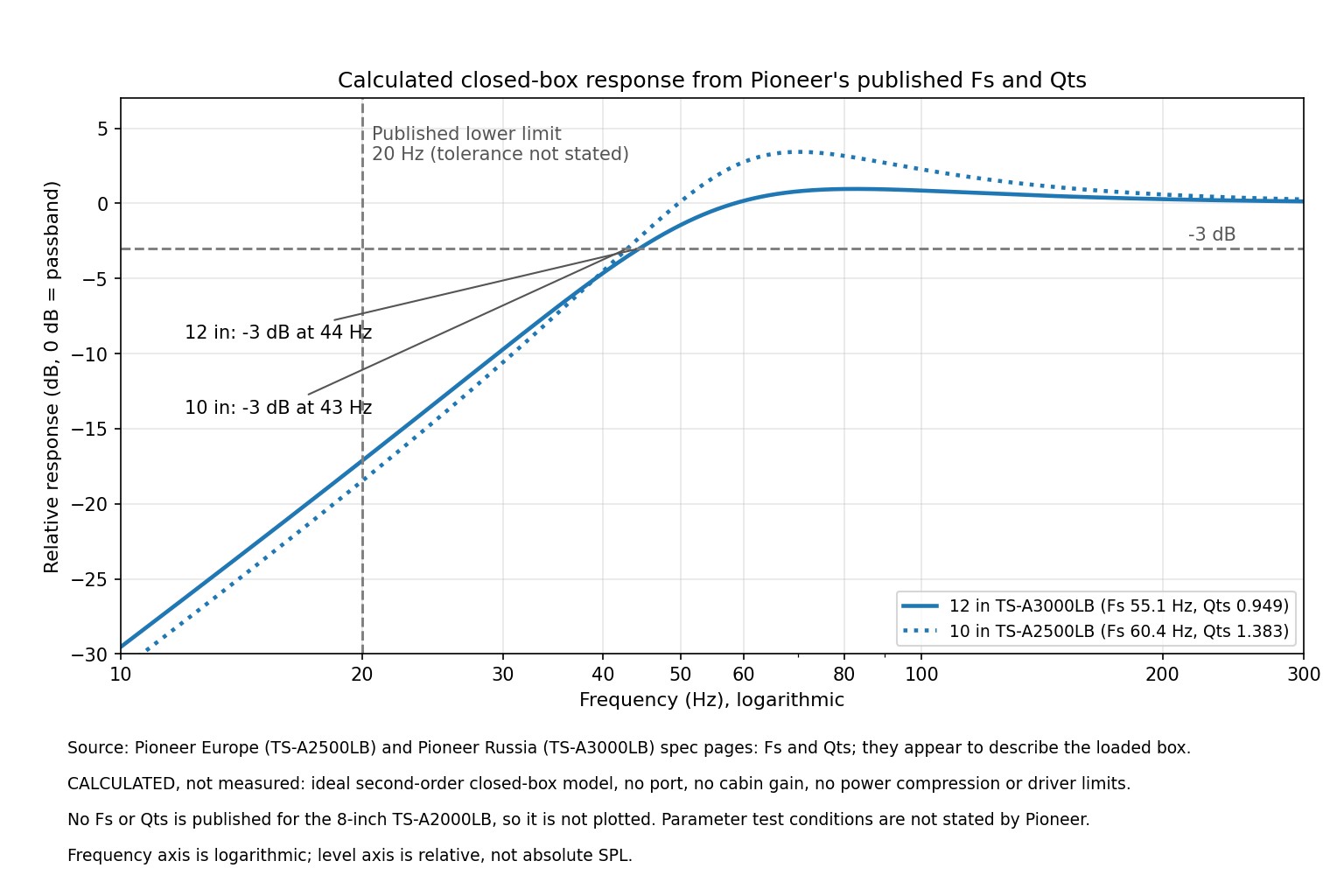
- Calculated -3 dB points of about 43 Hz (10 in) and 44 Hz (12 in) from Pioneer's own Fs and Qts, versus quoted 20 Hz lower limits
- Spec sheets conflict between regions, such as 20 versus 25 Hz and 83 versus 84 dB for the 8 in
- No independent measurements were found and several Amazon listing fields are wrong
- One-year warranty requires an authorized-dealer purchase, and Pioneer's terms have you ship the unit prepaid
- A 2-ohm single coil limits wiring to 2 ohms, 1 ohm (two parallel) or 4 ohms (two in series)
Specifications
| 12 in weight | 11.14 kg (Pioneer Russia); 8 in and 10 in weights vary by source |
|---|---|
| Box size (W x H x D) | 8 in: 13.75 x 9.875 x 5.125 in; 10 in: about 20.9 x 11.8 x 5.9 in; 12 in: 23.625 x 13.75 x 6.75 in |
| Cone and surround | Glass fiber and mica reinforced IMPP cone; rubber surround (butyl or SBR per source) |
| Enclosure | Sealed, carpeted box with steel mesh grille, feet and cushions; 10 in and 12 in described as 5/8 in MDF |
| Frequency range | 8 in: 20 Hz to 1.4 kHz (USA; 25 Hz on European pages); 10 in: 20 to 900 Hz; 12 in: 20 Hz to 1.0 kHz; tolerances not stated |
| In-box Fs / Qts (as published) | 10 in: 60.4 Hz / 1.383; 12 in: 55.1 Hz / 0.949; not published for 8 in |
| Included (8 in listing) | Pre-loaded enclosure, 4 threaded feet, 2 mounting brackets, 4 adhesive cushions, 8 screws, manual, warranty sheet |
| Models covered | TS-A2000LB (8 in), TS-A2500LB (10 in), TS-A3000LB (12 in) |
| Mounting | Upright, cone-up or down-firing using included threaded feet and brackets |
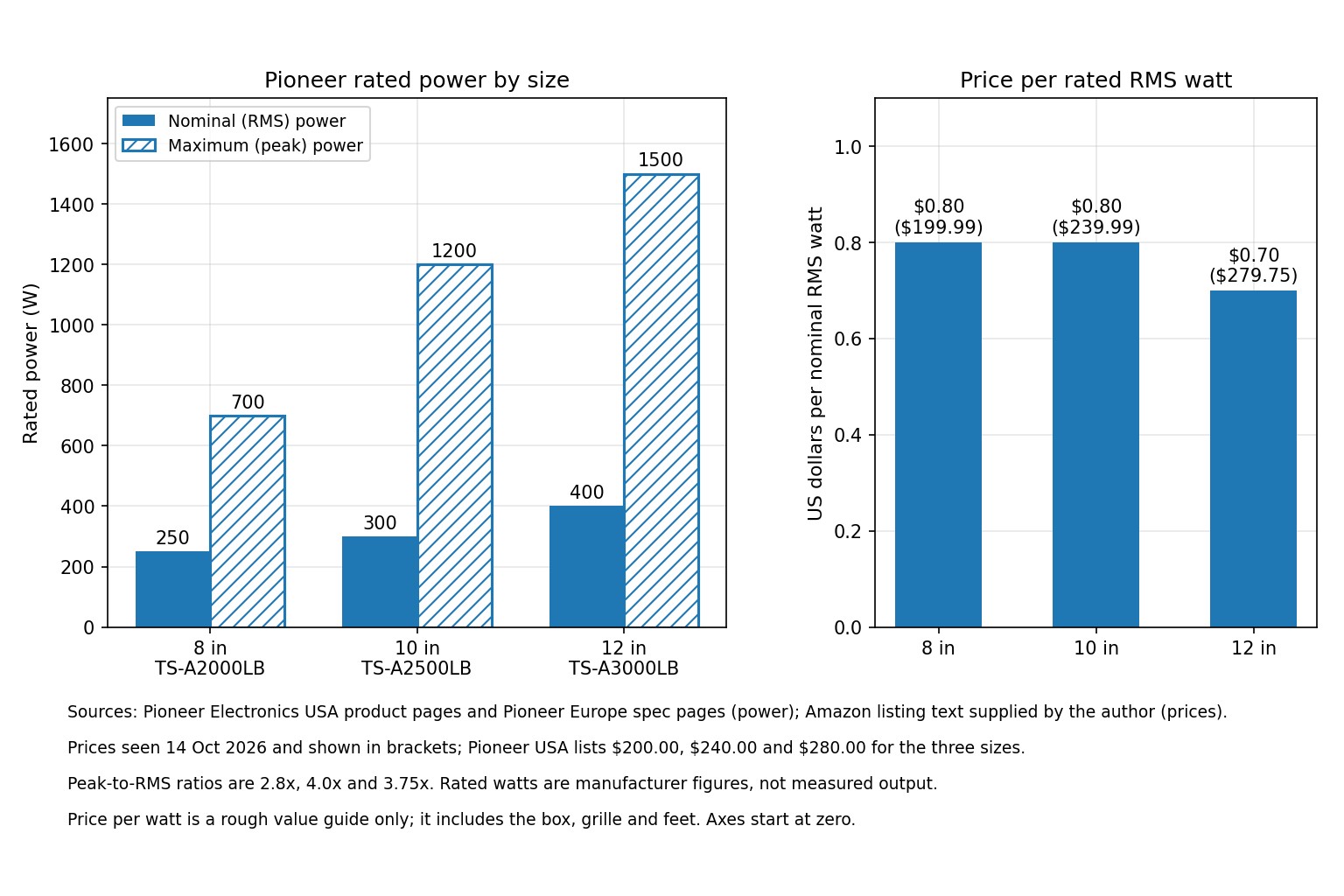
| Power (RMS / max) | 8 in: 250 / 700 W; 10 in: 300 / 1,200 W; 12 in: 400 / 1,500 W |
| Published Xmax | 10 in: 7.85 mm; 12 in: 8.8 mm; not published for 8 in |
| Sensitivity (1 W/1 m) | 8 in: 83 dB (USA) or 84 dB; 10 in: 88 dB (USA) or 86 dB (Europe); 12 in: 88 dB |
| Terminals | Angled binding-post push terminals |
| Voice coil and impedance | Single voice coil, 2 ohms, Kapton former (Pioneer Europe and Russia pages) |
| Warranty | 1 year; US warranty covers purchases from authorized Pioneer dealers |
Verdict
Pioneer's A-Series pre-loaded subwoofers suit buyers who want a simple, shallow sealed bass add-on in a small space with a modest 2-ohm amplifier. Their main strength is that the box, grille and feet are included at $199.99 to $279.75. The main compromise is limited depth and output, with modest published excursion and no independent measurements.
This Pioneer A-Series TS-A2000LB, TS-A2500LB and TS-A3000LB review covers three passive subwoofers supplied in shallow, sealed enclosures. The driver, carpeted box and grille come as one package, avoiding a separate enclosure build. The trade-off is limited air space. These models are intended to add bass where a conventional box will not fit, not to match a larger ported enclosure for deep extension or high output.
Pioneer A-Series design and build
All three models use a sealed enclosure with a carpeted outer surface, a steel-mesh grille and removable feet for different mounting positions. Pioneer specifies an injection-molded polypropylene cone reinforced with glass fiber and mica, a rubber surround, a ferrite magnet and one 2-ohm voice coil. The products are passive, so a separate amplifier and suitable wiring are required.
The dimensions are small in depth but not always small in width. The 8-inch model is the easiest to place in a tight space. The 10-inch enclosure is almost 21 inches wide, while the 12-inch version is nearly 24 inches wide. Check the full box outline, not just the speaker diameter, before ordering.
| Model | Driver size | Rated RMS / peak power | External box dimensions (W x H x D) | Calculated external volume |
|---|---|---|---|---|
| TS-A2000LB | 8 in | 250 / 700 W | 13.75 x 9.875 x 5.125 in | about 11.4 L |
| TS-A2500LB | 10 in | 300 / 1,200 W | 20.875 x 11.75 x 5.875 in | about 23.6 L |
| TS-A3000LB | 12 in | 400 / 1,500 W | 23.625 x 13.75 x 6.75 in | about 35.9 L |
The external volumes are calculations from Pioneer's published dimensions, not internal air-space figures. Pioneer does not publish net enclosure volume on the U.S. product pages. As a rough illustration, assuming 5/8-inch panels on every side gives about 6.9 L, 15.6 L and 25.2 L inside the three boxes before subtracting the driver and any internal hardware. Panel thickness is unconfirmed for every version, so treat these as estimates only.
Regional product information also differs on enclosure material. Some European Pioneer pages describe the box as particle board, while the U.S. pages do not state the panel material or thickness. The exact construction of a unit should be confirmed with the seller if material thickness matters for a particular installation.
Pioneer A-Series features, wiring and fitment
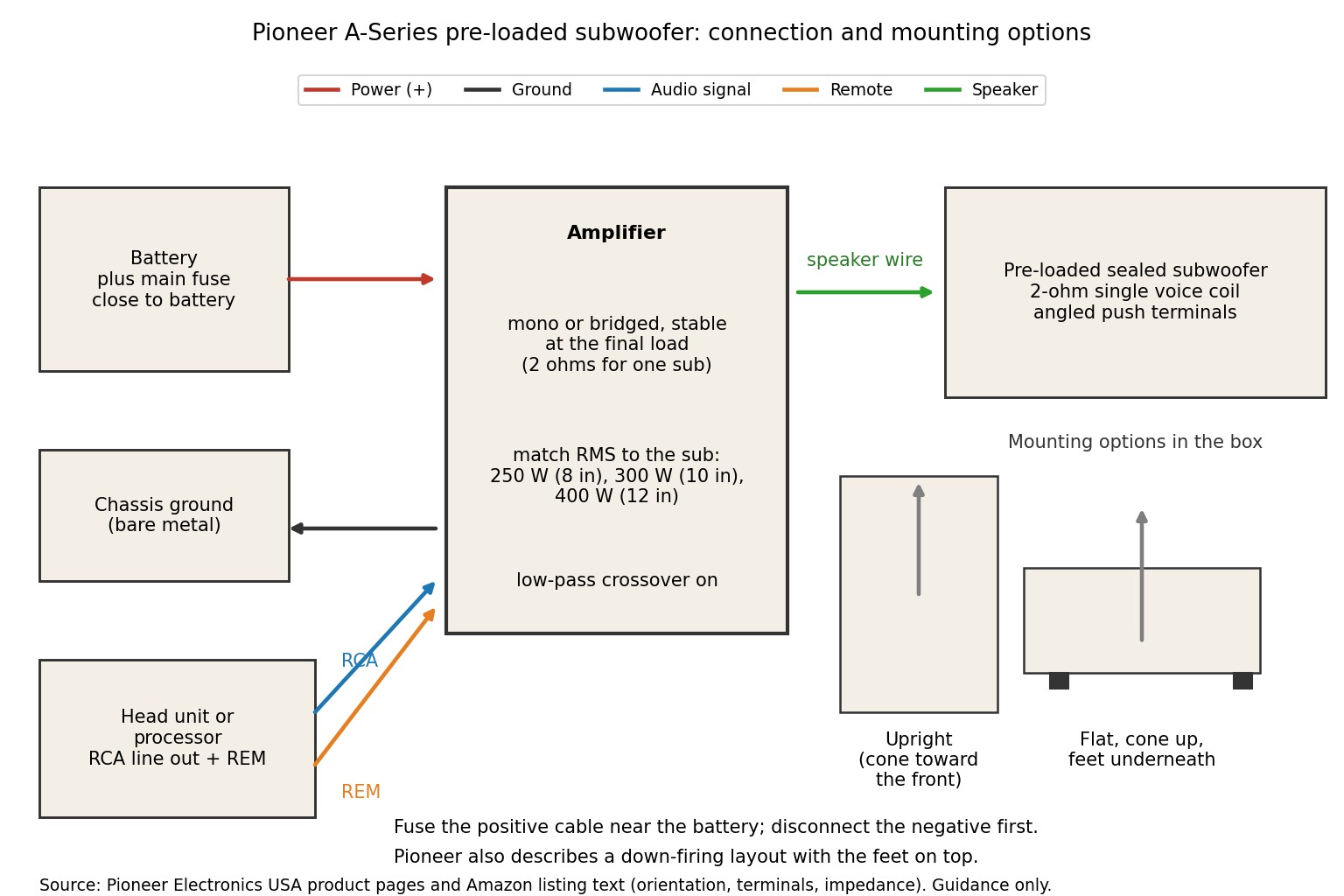
The main convenience is having the driver and enclosure as a single package. Pioneer confirms a grille and removable feet on its U.S. product pages. The feet allow the enclosure to stand upright, rest flat with the cone facing upward, or sit in a down-firing position, provided the chosen location leaves room for the grille and does not interfere with the car's interior. Review the exact contents listed for the regional model before assuming that every small mounting part or accessory is included.
Each model has one 2-ohm voice coil. That is a simple load for a compatible mono amplifier, but it leaves fewer wiring choices than a dual-voice-coil subwoofer. The load changes when two units are connected together, and the amplifier must be stable at the final impedance.
| Wiring setup | Load presented to the amplifier |
|---|---|
| One 2-ohm subwoofer | 2 ohms |
| Two 2-ohm subwoofers wired in parallel | 1 ohm |
| Two 2-ohm subwoofers wired in series | 4 ohms |
At each model's RMS rating into 2 ohms, the electrical values work out to the figures below. They are calculated from the rated power and nominal impedance, not recommended settings that every amplifier must reach.
| Driver size | RMS rating | Voltage at rated power | Current at rated power |
|---|---|---|---|
| 8 in | 250 W | 22.4 V | 11.2 A |
| 10 in | 300 W | 24.5 V | 12.2 A |
| 12 in | 400 W | 28.3 V | 14.1 A |
Before buying, check the car and amplifier against this list:
- Measure the available width, height and depth, including seat brackets, trim, wiring plugs and any movement of seat rails.
- Confirm the amplifier's RMS output at 2 ohms for one enclosure, or at the final load if two enclosures will be connected.
- Make sure the amplifier has an adjustable low-pass filter and follow its recommended gain-setting procedure.
- Plan a secure mounting point. The enclosure must not become a projectile during a sudden stop or crash.
- Keep the grille clear of bags and cargo, and do not block airbags, seat mechanisms, the spare-wheel area or emergency equipment.
- Check the model number and regional warranty before ordering; similarly named Pioneer subwoofers can have different impedance, enclosure or power ratings.
Pioneer A-Series sound and published performance data
Our research found no independent lab measurements for this model. Performance conclusions therefore have to stay within the manufacturer's published ratings and clearly identified calculations. Pioneer's descriptions of strong or deep bass are marketing claims rather than measured evidence of low-frequency output or distortion.
Regional specifications conflict, including within the U.S. TS-A2000LB page. Its main feature list gives 20 Hz to 1.4 kHz and 83 dB sensitivity, while a lower performance block gives 25 Hz to 1.4 kHz and 84 dB; the European page agrees with the latter figures. For the TS-A2500LB, the U.S. page lists 88 dB and 20 Hz to 1.0 kHz, while Europe lists 86 dB and 20 Hz to 900 Hz. The TS-A3000LB U.S. page lists 88 dB and 20 Hz to 1.0 kHz.
Pioneer does not give a measurement tolerance or full test conditions alongside these frequency-range figures, so a listed 20 Hz lower limit should not be read as proof of flat response to 20 Hz or as a minus-3 dB point. The sensitivity figures should also be treated cautiously because the regional pages do not establish that every number was obtained under the same conditions.
The European specification tables publish Thiele-Small figures for the 10- and 12-inch loaded systems. The TS-A2500LB is listed with Fs 60.4 Hz, Qts 1.383 and Xmax 7.85 mm. The TS-A3000LB is listed with Fs 55.1 Hz, Qts 0.949 and Xmax 8.8 mm. No comparable parameter set is published for the 8-inch loaded model in the sources listed below.
A closed-box response calculation using the published Fs and Qts values produces a broad rise of about 3.4 dB near 70 Hz for the 10-inch model and about 1 dB near 83 Hz for the 12-inch model. In the same model, the minus-3 dB points are roughly 43 Hz and 44 Hz. These are calculated response estimates from manufacturer-listed parameters; real in-car response also depends on the vehicle cabin and installation.
The small enclosure and moderate published excursion figures suit bass reinforcement more than sustained high output at the bottom of the audible range. The peak ratings of 700 W, 1,200 W and 1,500 W are respectively 2.8, 4.0 and 3.75 times the RMS ratings. Those ratios are arithmetic comparisons between the two published ratings; peak power should not be used as the amplifier-matching target. Choose an amplifier by its clean RMS output at the actual load.
Pioneer A-Series installation and daily use
These passive enclosures have no built-in amplifier, volume control or automatic turn-on; behaviour depends on the external amplifier. The shallow profile may suit under-seat or behind-seat placement, but dimensions do not guarantee vehicle fit.
Pioneer's manual includes connection and mounting guidance. Because installation involves the vehicle's electrical system, use an experienced installer if cable routing or grounding is unfamiliar. Follow the model manual:
- Disconnect the battery's negative terminal before starting electrical work and follow the vehicle maker's instructions for power disconnection.
- Install a fuse in the positive power lead close to the battery. Size the fuse and cable for the amplifier manufacturer's recommendations, not for the subwoofer's peak wattage.
- Use a secure ground point and route the power cable away from sharp edges, heat, moving mechanisms and existing vehicle wiring.
- Keep the enclosure fixed to a suitable mounting point. Adhesive cushions can help prevent movement but are not a substitute for secure restraint.
- Keep listening levels low enough to hear important traffic and emergency sounds. High sound pressure can damage hearing even when the bass does not seem harsh.
Pioneer A-Series comparison with two 10-inch alternatives
The 10-inch size gives a useful point of comparison. The alternatives with published manufacturer specifications are the Pioneer TS-D10LB and KICKER 44TCWC104. Their ratings use different conditions, so specification-sheet figures alone cannot establish which one will sound louder or extend lower in a specific car.
| Specification | Pioneer TS-A2500LB | Pioneer TS-D10LB | KICKER 44TCWC104 |
|---|---|---|---|
| Enclosure type | Sealed | Sealed | Ported, tuned to 35 Hz |
| Nominal impedance | 2 ohms, single voice coil | 2 ohms, single voice coil | 4 ohms |
| RMS / peak rating | 300 / 1,200 W | 350 / 1,300 W | 300 W recommended RMS / 600 W peak |
| Published sensitivity | 86 to 88 dB, depending on regional page | 74 dB | 93.8 dB |
| Published frequency information | 20 Hz to 900 Hz or 1.0 kHz, depending on regional page | 20 Hz to 3.4 kHz | 35 Hz enclosure tuning; full response range not stated on the current manufacturer page |
| Enclosure dimensions | 20.875 x 11.75 x 5.875 in | 20.875 x 11.75 x 5.875 in | 21.5 in wide x 15 in high; 4 to 7.625 in deep |
| Current published U.S. price | $240.00 on October 14, 2026 | $240.00 on the U.S. product page | Not listed on the current manufacturer page |
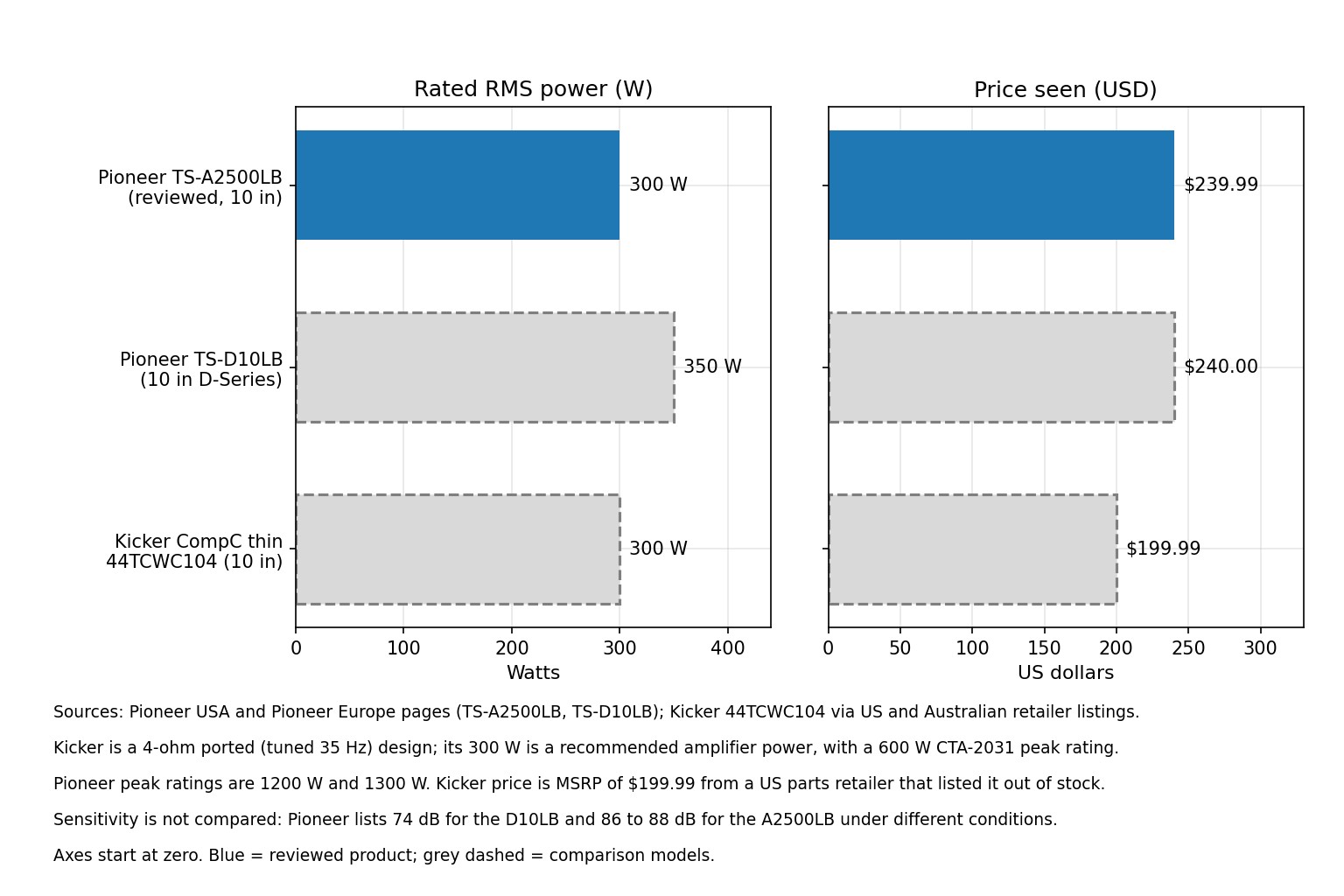
The Pioneer TS-D10LB has the same external dimensions and 2-ohm single-coil arrangement, but its RMS rating is 350 W. Its listed sensitivity is lower than the A-Series regional figures; the published conditions do not support a direct in-car loudness comparison. The specs also do not prove a practical advantage for either Pioneer design.
The KICKER 44TCWC104 is a ported 4-ohm enclosure tuned to 35 Hz. KICKER lists 300 W recommended RMS power and 600 W peak power. Its box is taller and deeper at the thickest point, and the current manufacturer page does not list a price.
Who should skip the Pioneer A-Series?
Skip these enclosures if the main goal is very low bass below about 40 Hz, strong output at high volume, or competition-level sound pressure. The listed data does not establish that these small sealed boxes can provide those results. They are also a poor fit if the available space cannot accommodate the full dimensions, if the amplifier is not stable at 2 ohms for a single enclosure, or if dual-voice-coil wiring options are needed. A larger sealed or properly designed ported enclosure is a better starting point for those priorities.
Pioneer A-Series price and buying checks
As of October 14, 2026, Pioneer USA listed the TS-A2000LB at $200, the TS-A2500LB at $240 and the TS-A3000LB at $280. Each U.S. product page showed the item as in stock and ready to ship on the date checked. These are U.S. direct prices; delivery, taxes, marketplace offers and prices in other countries can differ. Prices change often, so check the current listing. For marketplace availability, check the current price on Amazon , and confirm the listing matches the exact model and size you need.
Before paying, confirm the complete model number and compare the seller's dimensions with the space in the vehicle. Check the final amplifier load, its RMS output at that load, and whether the wiring kit includes suitable power cable, ground cable, fuse holder, RCA cable and remote turn-on lead. Ask the seller to confirm that the product is new, includes the grille and feet, and is intended for the market where it will be used.
Pioneer states that its U.S. limited warranty applies to products distributed by Pioneer Electronics (USA) Inc. and bought through authorized dealers in the United States and Canada. Its service page says warranty claims require a purchase receipt and that the item must be shipped to an authorized service location prepaid; return shipping is prepaid by Pioneer for covered repairs. The exact warranty period for these subwoofers was not confirmed from the accessible current warranty information, so check the written terms for the exact SKU and keep the receipt.
Pioneer A-Series final verdict and score
The three A-Series loaded enclosures make sense for a buyer who needs a shallow sealed box and prefers a ready-made package. The 8-inch TS-A2000LB is the easier fit for tight spaces; the TS-A2500LB is a middle option; and the TS-A3000LB has the highest RMS rating of the three. None should be selected on peak wattage alone, and their published response information does not establish strong output below 40 Hz.
The main limitations are the small enclosures, one 2-ohm voice coil per unit, modest published excursion figures and conflicting regional specifications. A larger or ported enclosure is the safer place to look for more low-frequency output, while buyers who need exact net box volume or independent distortion and output data may prefer a product with fuller technical documentation.
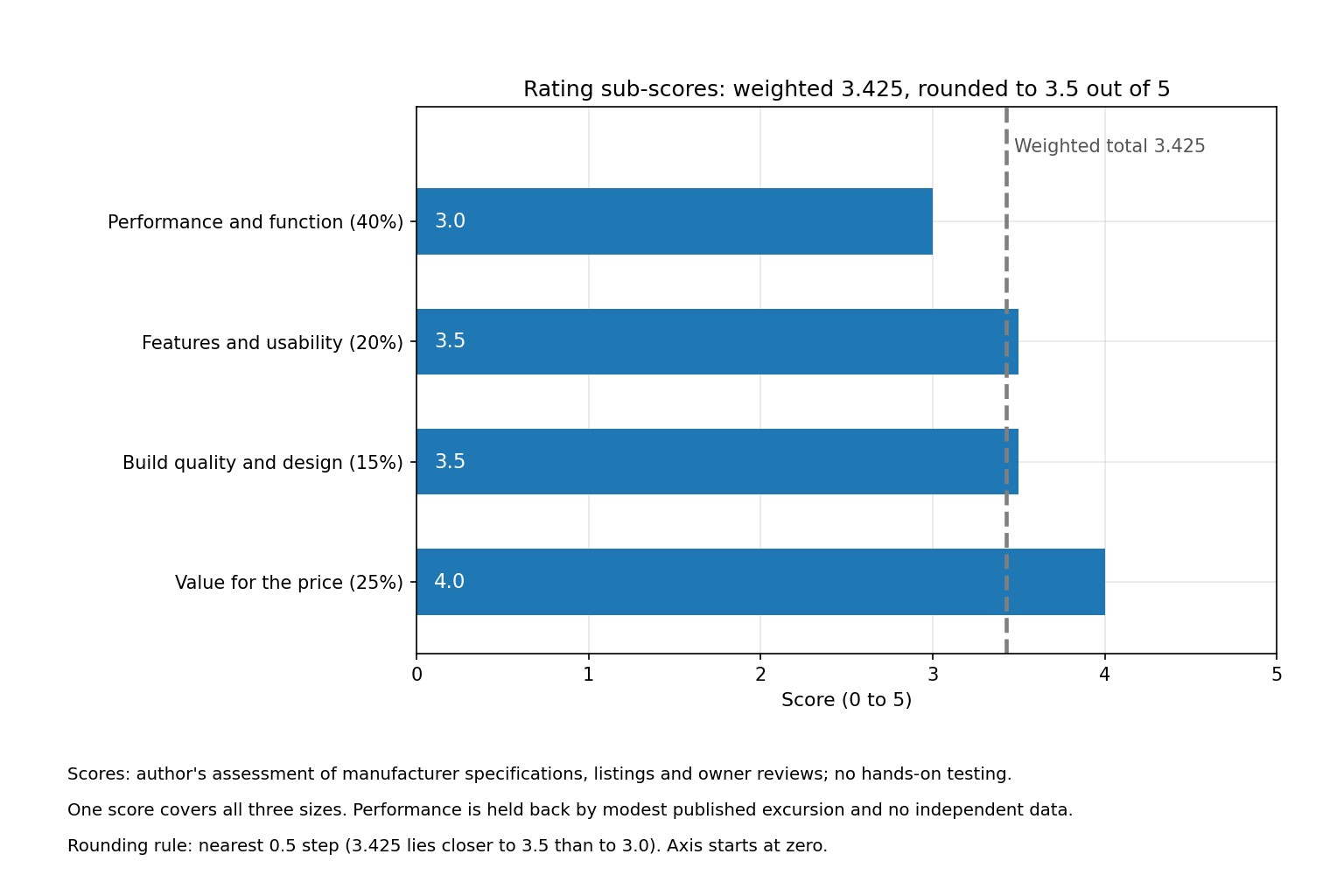
The product scores 3.5 out of 5 under a weighted rubric that gives performance and function 40 percent, features and usability 20 percent, build and design 15 percent, and value 25 percent. Our research score is based on the rated figures and documented details above.
| Criterion | Weight | Score | Weighted points | Basis |
|---|---|---|---|---|
| Performance and function | 40% | 3.0 | 1.200 | Small sealed boxes and limited published excursion |
| Features and usability | 20% | 3.5 | 0.700 | Loaded box, grille and removable feet; flexible orientation; 2-ohm single coil |
| Build quality and design | 15% | 3.5 | 0.525 | Carpeted shallow enclosures; panel material and thickness vary or are not confirmed by region |
| Value for the price at review | 25% | 4.0 | 1.000 | $200 to $280 U.S. direct price range for the three sizes as of October 14, 2026 |
| Total | 100% | 3.425 | Rounded to 3.5 out of 5 |
Sources and further reading
- Pioneer USA product specifications for the 8-inch model
- Pioneer USA product specifications for the 10-inch model
- Pioneer USA product specifications for the 12-inch model
- Pioneer Europe specifications for the 8-inch model
- Pioneer Malta specifications and Thiele-Small parameters for the 10-inch model
- Pioneer Malta specifications and Thiele-Small parameters for the 12-inch model
- Pioneer USA product specifications for the TS-D10LB
- KICKER manufacturer specifications for the 44TCWC104 enclosure
- Pioneer support page for the instruction manual and product warranty documents
- Pioneer USA authorized-dealer and warranty eligibility information
Pioneer TS-A2000LB, A2500LB and A3000LB FAQ
Which size should I choose: 8, 10 or 12 inch?
Pick by space and amplifier power. The 8-inch (250 W RMS) fits the tightest spots, the 10-inch (300 W) is a middle option and the 12-inch (400 W) gives the most output within a shallow footprint. Measure width and depth first, because the 12-inch box is 23.6 inches wide.
What amplifier do these subwoofers need?
They need an amplifier that is stable at 2 ohms for one subwoofer and that has a low-pass crossover. Match its RMS output to the subwoofer's rating of 250, 300 or 400 W rather than to the peak rating. Higher peak numbers are not a target.
Can I wire two of them together?
Yes, but check your amplifier first. Two in parallel make a 1-ohm load and two in series make a 4-ohm load, which is simple series and parallel arithmetic. The amplifier must be rated for the final load.
Do I need to build a box?
No. Each model is pre-loaded in a sealed enclosure with a steel mesh grille. The 8-inch listing also includes feet, brackets, cushions and screws.
How low do they really go?
Pioneer quotes a 20 Hz lower limit without a tolerance. Calculating from Pioneer's published Fs and Qts gives -3 dB points near 43 Hz for the 10-inch and 44 Hz for the 12-inch, which is a model rather than a measurement. Treat them as upper-bass reinforcement rather than deep bass.
What is the warranty?
Pioneer USA's limited warranty is one year for speakers and car electronics bought from an authorized US dealer. You need proof of purchase, and the terms have you ship the product prepaid to a service company, with Pioneer paying the return shipping. Confirm the seller's status before buying.
Is the TS-A2000LB worth the money?
At $199.99 it includes the box, grille and feet, which makes it good value for a basic bass add-on. It is not a high-output or deep-bass subwoofer, and I found no independent measurements. It makes sense if space is tight and you want a simple install.
Will it fit under my seat or in my truck?
The 8-inch box is 13.75 x 9.875 x 5.125 inches and the 12-inch is 23.625 x 13.75 x 6.75 inches. Pioneer says the shallow shape fits many vehicles including pickups with standard or extended cabs. Measure your space, including depth, before ordering.