Helix · P SIX DSP MK2
Helix P SIX DSP MK2 Review: Mighty, but Outdated
Research review of the Helix P SIX DSP MK2: 6-channel Class D amp, 8-channel DSP, 120 W x 6 at 4 ohms, magazine lab results and the newer P SIX DSP Ultimate.
Pros
- Rated 120 W on all six channels at 4 ohms and 230 W on channels C to F at 2 ohms
- A magazine lab measured 116 to 123 W at 4 ohms and about 195 W per channel at 2 ohms on C to F
- Compact 50 x 260 x 190 mm aluminium case with a built-in 8-channel, 64-bit, 96 kHz DSP
- High-level inputs with the ADEP circuit help factory radios avoid speaker fault messages
- Same rated performance on 12 V and 24 V systems, with tolerance of supply dips to 6 V
- HEC slot allows optional Bluetooth, aux, optical or USB audio cards
Cons
- Archived by the manufacturer and replaced by the P SIX DSP Ultimate, so new stock and warranty are uncertain
- Channels A and B are limited to 4 ohms and no channel can be bridged, so subwoofers need dual voice coils or another amp
- Only two processed RCA outputs and one optical input (stereo PCM only, no coaxial input)
- The magazine measured about 195 W at 2 ohms against a 230 W rating and about 91 dB SNR against 100 dB claimed
- Stores two sound setups and the listed software download is DSP PC-Tool 4, versus ten setups on the Ultimate
- Current MK2 price could not be verified, so value for money is hard to judge
Specifications
| Amplifier channels | 6 (A to F); A and B stable to 4 ohms, C to F stable to 2 ohms; not bridgeable |
|---|---|
| Amplifier technology | Ultra HD Class D |
| DSP | 8 channels, 64-bit fixed point, 295 MHz (1.2 billion MAC/s), 96 kHz sampling |
| Damping factor | Above 100 |
| Dimensions (H x W x D) | 50 x 260 x 190 mm |
| Expansion | HELIX Extension Card (HEC) slot |
| Frequency response | 20 Hz to 44,000 Hz |
| Idle current | 2200 mA |
| Inputs | 6 x RCA; 6 x high-level with ADEP circuit; 1 x optical S/PDIF (12 to 96 kHz, stereo PCM); 1 x remote in |
| Internal fuses | 3 x 20 A mini (APS) |
| Max. power per channel (typical multichannel use) | Up to 140 W at 4 ohms; up to 260 W at 2 ohms (channels C to F) |
| Operating voltage | 10.5 to 32 V (12 V and 24 V systems); down to 6 V for up to 5 s |
| Outputs | 6 x speaker; 2 x RCA (processed, 3 V RMS); 2 x remote out |
| Power (RMS) | 6 x 120 W at 4 ohms; 4 x 230 W at 2 ohms (channels C to F); 1% THD+N or less |
| Signal-to-noise ratio (claimed) | 100 dB(A) analog input; 105 dB(A) digital input |
| THD (claimed) | Below 0.008 % (test conditions not stated) |
Verdict
The Helix P SIX DSP MK2 suits builders who want a compact six-channel amplifier and eight-channel DSP in one box, including 24 V vehicles. Its main strength is high rated power, backed by a magazine lab test at 4 ohms. The main compromise is age: it sits in the manufacturer's archive and the Ultimate has replaced it. A current MK2 price could not be verified, so it only makes sense well below Ultimate pricing.
Short answer: the Helix P SIX DSP MK2 is a well-regarded, compact six-channel Class D amplifier with a built-in eight-channel DSP, but it is no longer the model to look at first. Audiotec Fischer lists it in its product archive, and the company's current flagship in the same case is the P SIX DSP Ultimate. The MK2 makes sense mainly if you find a genuinely new, warrantied unit at a price clearly below the Ultimate and you accept an older feature set. I could not verify a current MK2 price, so this review leans on specifications and independent test data rather than on a price comparison.
How this review was made
This is a specification and research review. I did not install, listen to or measure this amplifier, and nothing here is hands-on experience. It draws on Audiotec Fischer's product page and manual, a February 2016 lab test by the German magazine Car&HiFi (the copy I read is hosted by the manufacturer, which is worth keeping in mind), the manufacturer's pages for the P SIX DSP Ultimate and M SIX DSP, a retailer page for the JL Audio VX600/6i, and a few owner forum threads that I treat as anecdotal. Sources were checked on 12 October 2026. Anything I could not confirm is left out or marked as not confirmed. Statements about sound are attributed to the magazine's listening notes and measurements, not to my own ears.
Design and build
The MK2 uses a solid aluminium case measuring 50 x 260 x 190 mm (height, width, depth), low enough to fit under many seats. A weight was not published in the sources I could verify. The casing carries a clipping LED and a fuse-status LED, and inside sit three 20 A mini fuses. Car&HiFi called the amplifier mechanically and electronically at its best and noted that the power supply uses a step-up converter instead of a transformer. It also pointed out that the board has five power-stage chips: four serve channels C to F, while A and B share one. That sharing is why channels A and B are limited to 4 ohms while C to F tolerate 2 ohms.
The input-range jumpers sit inside the case; changing them means removing ten screws from the bottom plate, per the manual.
Features and usability
The amplifier takes six RCA channels, six high-level (speaker-level) channels and one optical S/PDIF input. The high-level inputs use Audiotec Fischer's ADEP circuit, designed so that factory radios that monitor their speaker outputs do not raise fault messages or drop functions such as the fader. Input sensitivity is set per channel pair with three potentiometers, with factory ranges of 2 to 4 V for RCA and 5 to 10 V for high-level; the internal jumpers move those to 4 to 8 V and 10 to 20 V. The optical input accepts uncompressed stereo PCM from 12 to 96 kHz only, so Dolby and compressed streams are not supported, and there is no coaxial digital input (the Ultimate adds one).
Outputs are six speaker channels, two processed RCA outputs at up to 3 V RMS for feeding another amplifier, and two remote outputs. Counting those two RCA outputs, the DSP handles eight processed channels. Car&HiFi lists a 30-band parametric EQ per channel (+6 to -15 dB, Q 0.5 to 15), several crossover alignments up to 42 dB per octave, phase adjustment in 11.25-degree steps, and time correction from 0 to 318 cm in 3.5 mm steps, plus a real-time analyser that needs an optional measurement microphone. According to the manual the unit stores two sound setups, switched with a button on the amp; the Ultimate stores ten.
Housekeeping features include a Power Save Mode that switches the output stages off after 60 seconds without a signal (adjustable in the software), tolerance of supply dips to 6 V during cranking, automatic switching to the optical input, and 12 V or 24 V operation with the same rated performance. A HELIX Extension Card (HEC) slot accepts optional modules; the manufacturer lists a Bluetooth streaming card, an aux input card, an optical card and a high-resolution USB audio interface. Bluetooth is not built in, and fitting a card means swapping a side panel.
Setup is done on a computer through Audiotec Fischer's DSP PC-Tool over USB. The MK2 page links the version 4 download; whether newer tool versions work with the MK2 is not something I could confirm.
Sound and performance
Everything in this section comes from manufacturer numbers and the Car&HiFi test. None of it is my own listening. According to the magazine's lab, the two small channels delivered about 116 W each at 4 ohms and the four large channels about 123 W, against a rating of 120 W. At 2 ohms the large channels managed roughly 195 W each, below the 230 W rating but still a large figure for an amplifier this size. The magazine measured an average signal-to-noise ratio of about 91 dB, lower than the 100 dB (analog input) and 105 dB (digital input) the manufacturer claims, although the conditions behind each figure are not spelled out. Distortion was described as comfortably low, though not at the level of the company's analog Brax amplifiers; I found no numeric THD+N table in the text I could read.
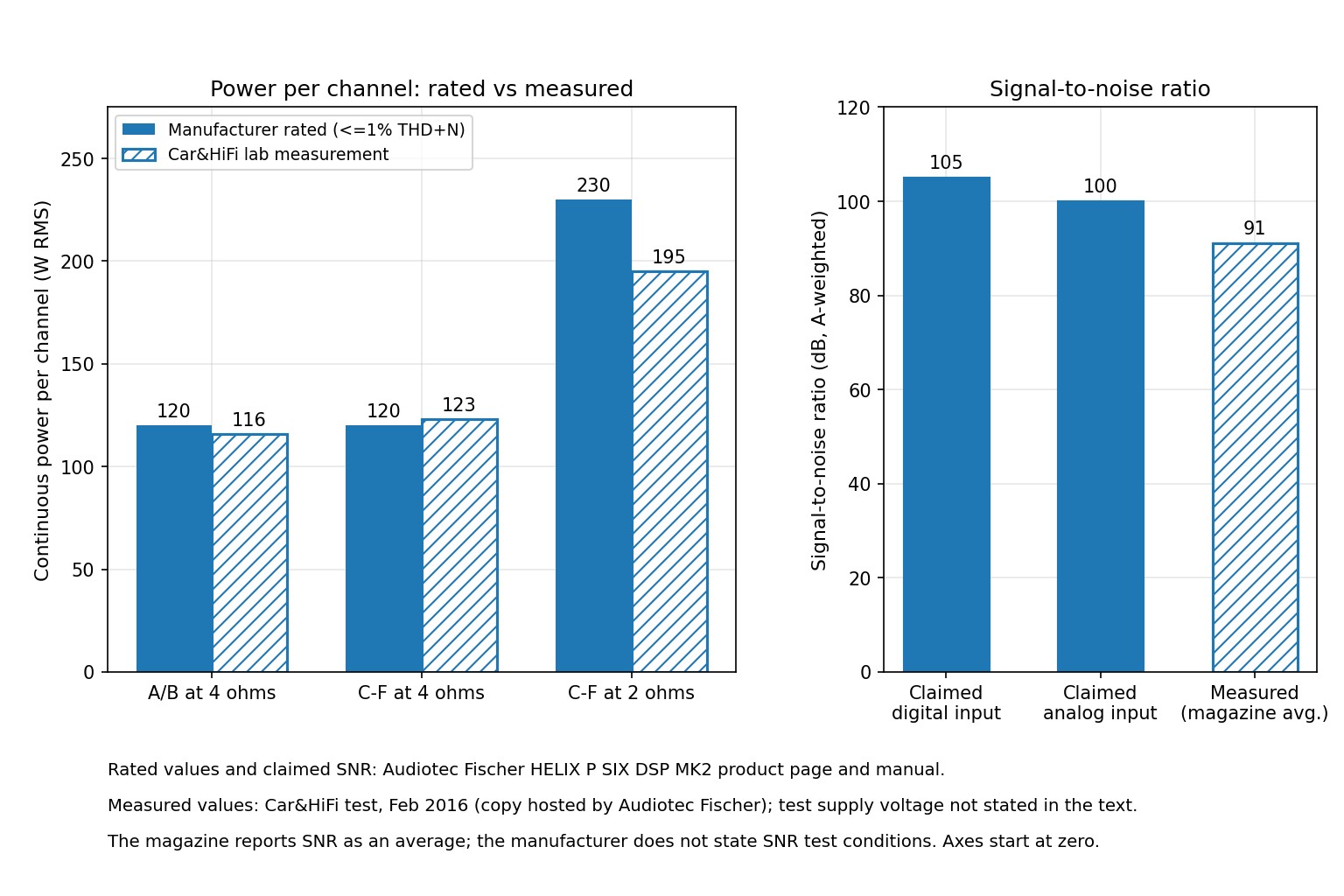
The 2-ohm shortfall deserves a note. At 2 ohms the measured 195 W is about 15 percent below the 230 W rating, while the 4-ohm results sit within about 3 percent of the 120 W rating. Test conditions differ between labs, so read the headline rating as an upper bound rather than a promise.
The magazine's listening notes describe a tonal balance that is neither too warm nor too cold, an easy character at both low and high volume, and precise bass and dynamics. It rated the amplifier top-notch overall and called it the digital reference. Two caveats: this was a 2016 test of a then-new product, and the manufacturer-hosted copy suggests a favourable selection. Owner forum posts I read were mostly positive about the DSP section, while a few owners prefer class AB amplifiers for tone; those are individual opinions, not measurements.
The magazine also noted that the MK2's Texas Instruments power chips allow the full 44 kHz bandwidth, but the extremely high damping factors of the first-generation P SIX DSP are gone. The manufacturer's spec sheet still lists a damping factor above 100.
Setup, installation and daily use
This is not a beginner's plug-in amplifier. The manual recommends an authorised Helix dealer and links full warranty coverage to proper installation. The list below summarises the manual; it does not replace it.
- Disconnect the negative battery terminal first. Fit a main fuse in the positive cable within 30 cm of the battery, sized to the total current of the whole audio system. The manual gives the amplifier's own figure as a maximum of 60 A RMS on 12 V and 30 A RMS on 24 V.
- Use at least 16 mm² (AWG 6) power cable for runs under 1 m and 25 to 35 mm² (AWG 4 to 2) for longer runs. The ground cable should be the same gauge and go to bare chassis metal or the battery negative.
- Never use the RCA and high-level inputs at the same time; the manual warns this can damage the radio's outputs. Connect the REM line to the radio's remote output when using RCA or optical input, and avoid switching it from the ignition because of on and off noise.
- Match input sensitivity to the source before connecting speakers. The manual describes using a 1 kHz test tone and the clipping LED.
- Configure the DSP, especially crossovers, before connecting speakers. The manual warns that a wrong setup in a fully active system can destroy tweeters.
- A digital source normally has no volume control, so the optical input can deliver full level at every output. The manual strongly advises an optional remote for volume.
- Respect the load limits: 4 ohms minimum on A and B, 2 ohms minimum on C to F, and no bridging. For subwoofers the manual recommends dual-voice-coil drivers.
Mount the amplifier on a solid surface with airflow, and check behind the mounting area for wiring, brake lines and the fuel tank before drilling. One piece of arithmetic worth knowing: 60 A at 12 V is about 720 W of electrical input, which is less than the 1,160 W you get by adding every rated channel output (2 x 120 W plus 4 x 230 W). The manual does not state the conditions behind the 60 A figure, so read the per-channel ratings as individual capability and size the electrics for how you actually listen.
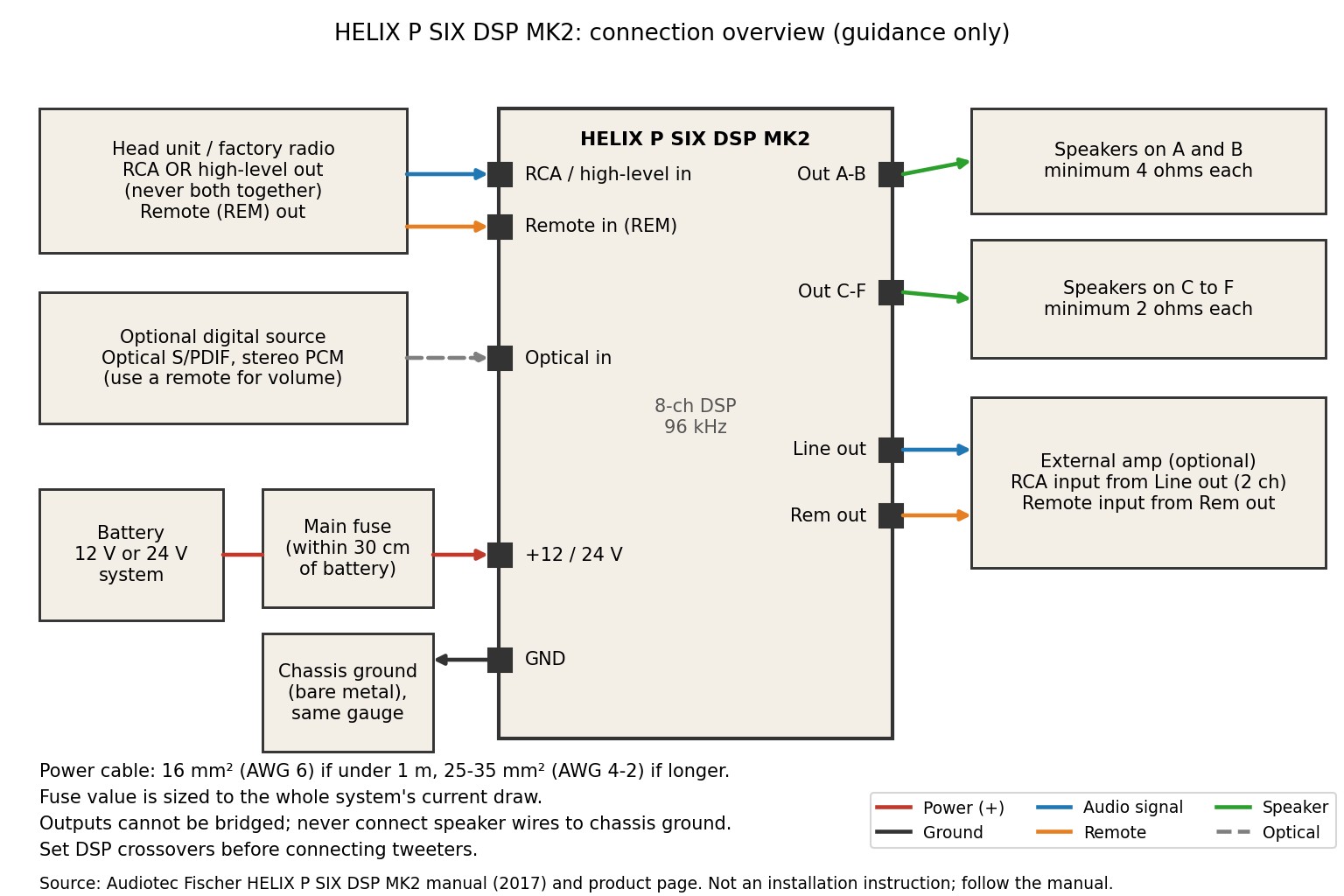
In daily use the amplifier turns itself on from a high-level signal or the REM line, drops into Power Save after 60 seconds of silence and wakes again within about one to two seconds (the product page says one second, the manual says two). The manual also notes that some CAN-bus cars keep the radio running "invisibly" for up to 45 minutes after you leave, which is where Power Save earns its keep.
How it compares
The table uses manufacturer specifications. Ratings from different brands use different test voltages, so treat cross-brand power figures as indicative.
| Spec | P SIX DSP MK2 (reviewed) | P SIX DSP Ultimate | HELIX M SIX DSP | JL Audio VX600/6i |
|---|---|---|---|---|
| Amplifier channels | 6 | 6 | 6 | 6 |
| RMS per channel at 4 ohms | 120 W (A to F) | 120 W (A to F) | 100 W | 75 W (14.4 V) |
| RMS per channel at 2 ohms | 230 W (C to F only) | 230 W (C to F only) | 100 W | 100 W (14.4 V) |
| Bridged output | Not allowed | Not rated | 3 x 200 W at 4 ohms | 3 x 200 W at 4 ohms (14.4 V) |
| DSP | 8 channels, 64-bit, 1.2 billion MAC/s | 12 channels, two 64-bit DSPs, 2.4 billion MAC/s | 10 channels, 64-bit, 1.2 billion MAC/s | Triple-core AKM DSP; channel count not confirmed |
| Sampling rate, bandwidth | 96 kHz, 20 Hz to 44 kHz | 96 kHz, 10 Hz to 44 kHz | 48 kHz, 20 Hz to 22 kHz | Not confirmed |
| Digital input | Optical (12 to 96 kHz) | Optical and coaxial (to 192 kHz) | Optical (12 to 96 kHz) | 2-ch S/PDIF in (to 192 kHz) and out (96 kHz) |
| Processed RCA outputs | 2 (3 V) | 4 (3 V) | 4 (6 V) | 2 (4 V) |
| Size (H x W x D) | 50 x 260 x 190 mm | 50 x 260 x 190 mm | 50 x 320 x 154 mm | Not confirmed |
| Price context, 12 Oct 2026 | Not verified | EUR 1,499 at one EU retailer | About EUR 699 (sale price) at the same retailer | Not verified |
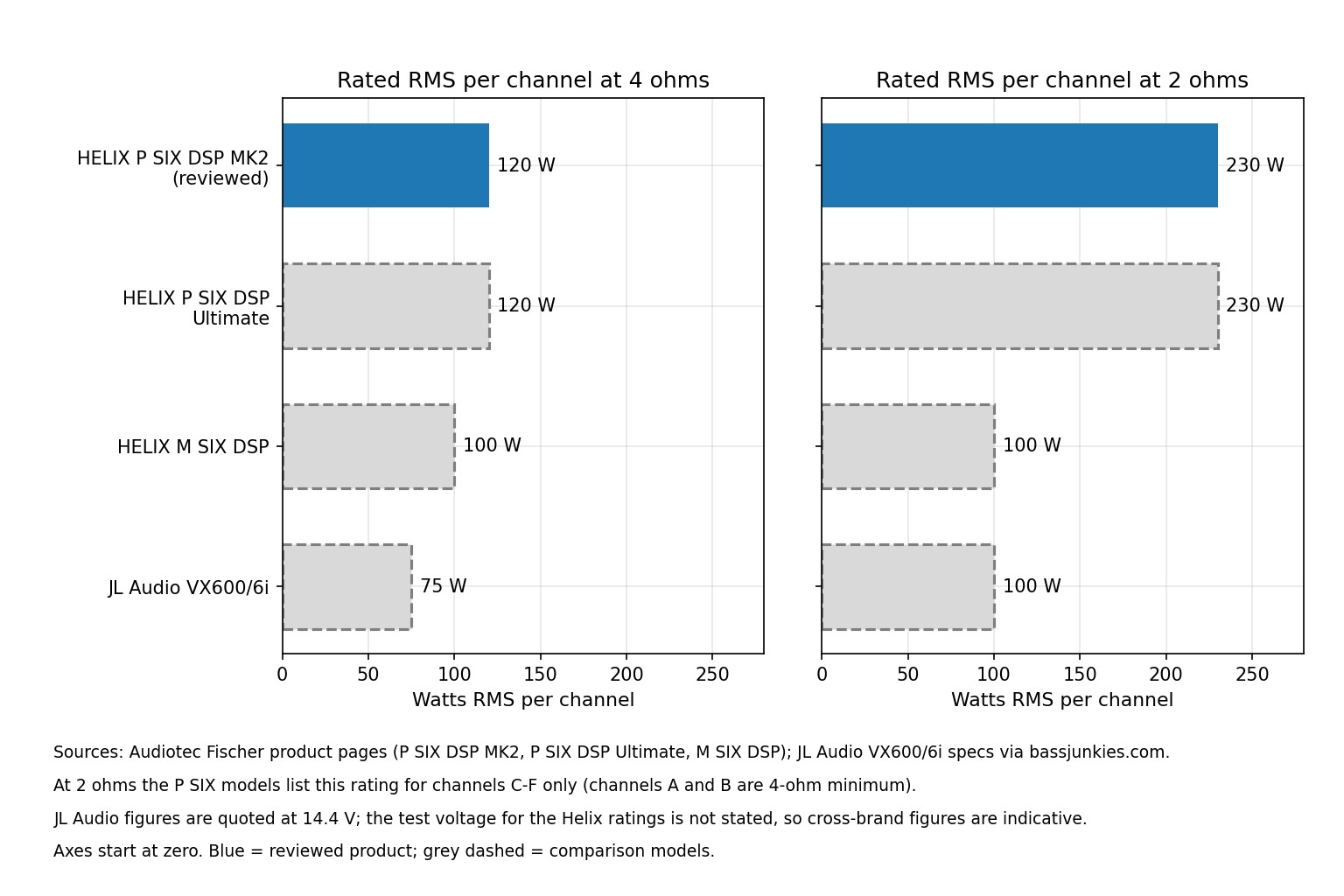
Against its siblings, the MK2 matches the Ultimate's rated power with a smaller DSP and fewer outputs, while the M SIX DSP trades power and bandwidth for a lower price. The JL Audio VX600/6i rates lower in power but has its own DSP, S/PDIF in and out, and app-based tuning. The MK2's niche is Ultimate-class power and 96 kHz processing at a discount.
Who should buy it and who should skip it
It suits a builder who wants a compact amplifier and DSP in one box, for example an active front stage plus a processed feed to a separate subwoofer amplifier, or an upgrade behind a factory radio using the high-level inputs. It also suits 24 V vehicles, since performance is rated the same on 12 V and 24 V. Skip it if you want automatic EQ correction, an input analyser for factory radios, 12 processed channels, a coaxial input or ten stored setups; the Ultimate covers most of that. Also skip it if no seller can document new stock and warranty.
Buying advice
Because the MK2 is archived, first work out whether the unit is new or used and who is selling it. Ask for the part number (P816002) and serial number, get the warranty terms in writing, and read the return policy. The manufacturer's manual states that warranty follows the legal requirements and excludes damage from overload or improper use. The MK2 listings I saw were mixed: some marked sold out, others from individual sellers whose condition and dates I could not verify.
For price context, one EU retailer listed the Ultimate at EUR 1,499 and the M SIX DSP at about EUR 699 on 12 October 2026, and a US specialist listed the Ultimate at USD 2,100. An MK2 only makes financial sense if it comes in well below the Ultimate, and where that line sits depends on the unit's condition and warranty.
Budget for extras: power and ground cable, a fuse holder, RCA cables or the optional Easy Plug Cable (EPC 5), a computer for the DSP software, a measurement microphone for the analyser, and a remote if you use the digital input. For Bluetooth, confirm the card is listed for the MK2; newer cards sold with the Ultimate are not confirmed to fit.
Final thoughts
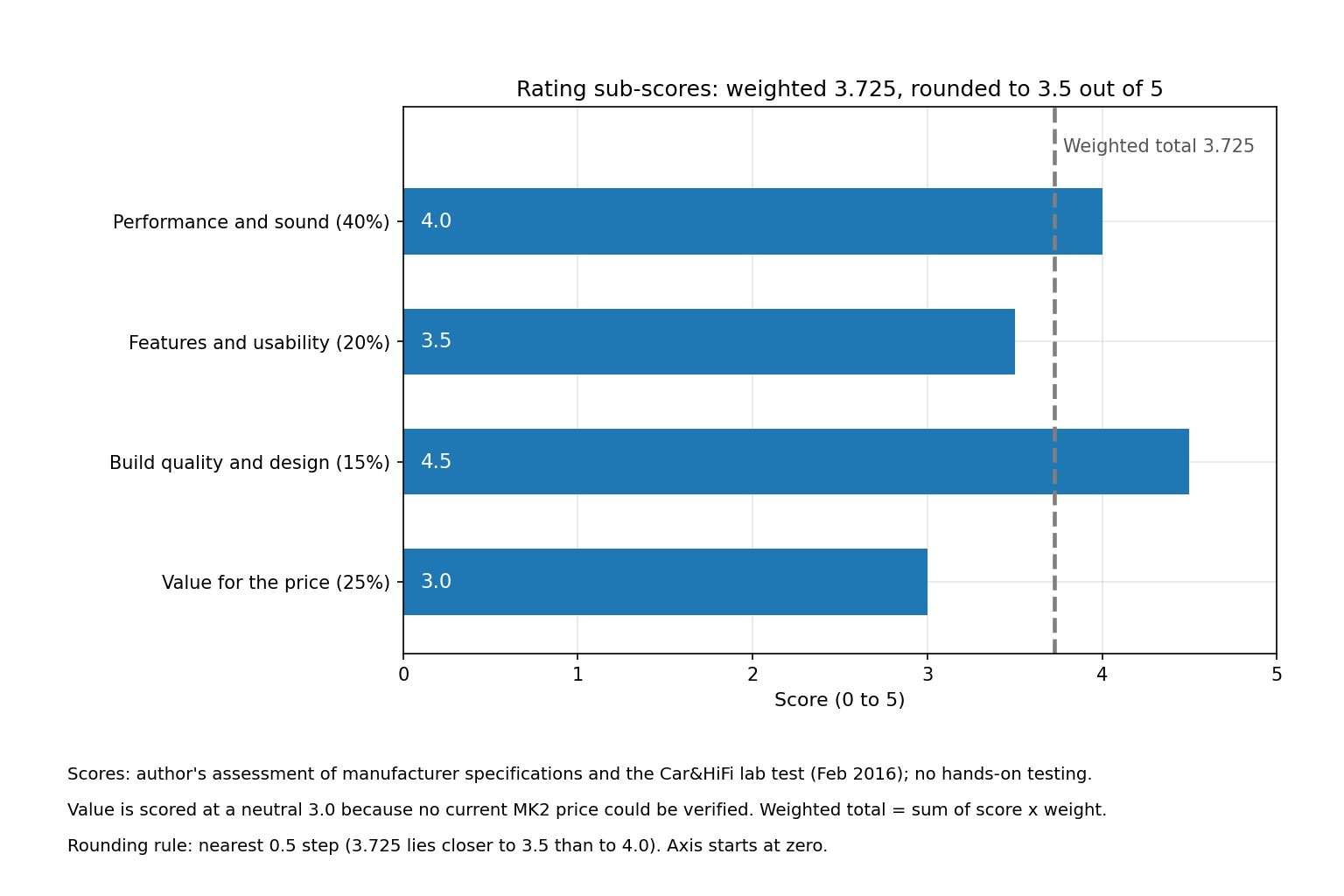
I rate the Helix P SIX DSP MK2 3.5 out of 5. The rubric weights performance and sound at 40 percent, features and usability at 20 percent, build quality and design at 15 percent and value at 25 percent. This is a research-based rating: it rests on the manufacturer's data and one independent lab test, not on hands-on use. The weighted score is 3.725, rounded to the nearest half point. The Verdict, Pros and Cons panels on this page summarise the conclusions.
| Criterion | Weight | Score | Weighted points | Basis |
|---|---|---|---|---|
| Performance and sound | 40% | 4.0 | 1.600 | 4-ohm power within about 3% of rating; 2-ohm power and SNR below claims |
| Features and usability | 20% | 3.5 | 0.700 | Solid inputs and DSP, but two setups, two RCA outputs and an older platform |
| Build quality and design | 15% | 4.5 | 0.675 | Aluminium case, German manufacture, build praised in the magazine test |
| Value for the price at review | 25% | 3.0 | 0.750 | Neutral score: no verified MK2 price and a newer model exists |
| Total | 100% | 3.725 | Rounded to 3.5 |
Some links on this page are affiliate links; they never affect our ratings. As an Amazon Associate I earn from qualifying purchases.
Sources and further reading
- Audiotec Fischer: HELIX P SIX DSP MK2 product page
- HELIX P SIX DSP MK2 instruction manual (PDF)
- Car&HiFi test, February 2016, as hosted by Audiotec Fischer (PDF)
- Audiotec Fischer: HELIX P SIX DSP ULTIMATE product page
- Audiotec Fischer: HELIX M SIX DSP product page
- Retailer specification page: JL Audio VX600/6i
- Retailer listing used for Ultimate price context
Helix P SIX DSP MK2 FAQ
Is the Helix P SIX DSP MK2 still made?
Audiotec Fischer's site files it under its product archive, and the company's current model in the same case is the P SIX DSP Ultimate. I could not find a discontinuation date, so ask a dealer whether any new MK2 stock remains.
What is the difference between the MK2 and the Ultimate?
Both list 120 W x 6 at 4 ohms and 230 W x 4 at 2 ohms. The Ultimate adds a 12-channel DSP with two processors, a coaxial input, four RCA outputs, an optical output, ten stored setups and tools such as TuneEQ. The MK2 has an 8-channel DSP, two RCA outputs and two stored setups.
Can the P SIX DSP MK2 power a subwoofer?
Channels C to F handle 2 ohms, but no channel can be bridged and A and B are limited to 4 ohms. The manual recommends dual-voice-coil subwoofers. You can also use the two processed RCA outputs to feed a separate subwoofer amplifier.
Will it work with a factory radio?
Yes, it has six high-level inputs with the ADEP circuit, designed to keep factory radios from reporting speaker faults. Input ranges can be changed with internal jumpers, and the manual lists an Easy Plug Cable (EPC 5) for some installs. Check your vehicle, because some cars need extra adapters.
Does it have Bluetooth?
Not built in. The HEC slot accepts an optional Bluetooth streaming card, and the manufacturer also lists aux, optical and USB audio cards. Confirm that any card you buy is listed for the MK2, since newer cards sold with the Ultimate are not confirmed to fit.
Can I run it on a 24 V system?
Yes. It accepts 10.5 to 32 V and the manufacturer says performance is identical on 12 V and 24 V without changing anything on the unit. This makes it usable in trucks and buses.
What power wire and fuse does it need?
The manual calls for at least 16 mm² (AWG 6) cable on short runs under 1 m and 25 to 35 mm² on longer ones. A main fuse goes within 30 cm of the battery and is sized to the whole system. The amplifier itself is listed at up to 60 A RMS on 12 V.
Is the P SIX DSP MK2 worth buying today?
It can be, but only if you find a new or well-documented unit well below Ultimate pricing. The rated power matches the Ultimate and a magazine lab test was favourable in 2016. The Ultimate offers more DSP channels and features, and I could not verify a current MK2 price.