AudioControl · LC2i PRO
AudioControl LC2i PRO Review: Active LOC for Factory Stereos
Active 2-channel line output converter with 40 V input, 9.5 V output, load select, ground isolation and AccuBASS. Specs, rivals and buying advice at $169.
Pros
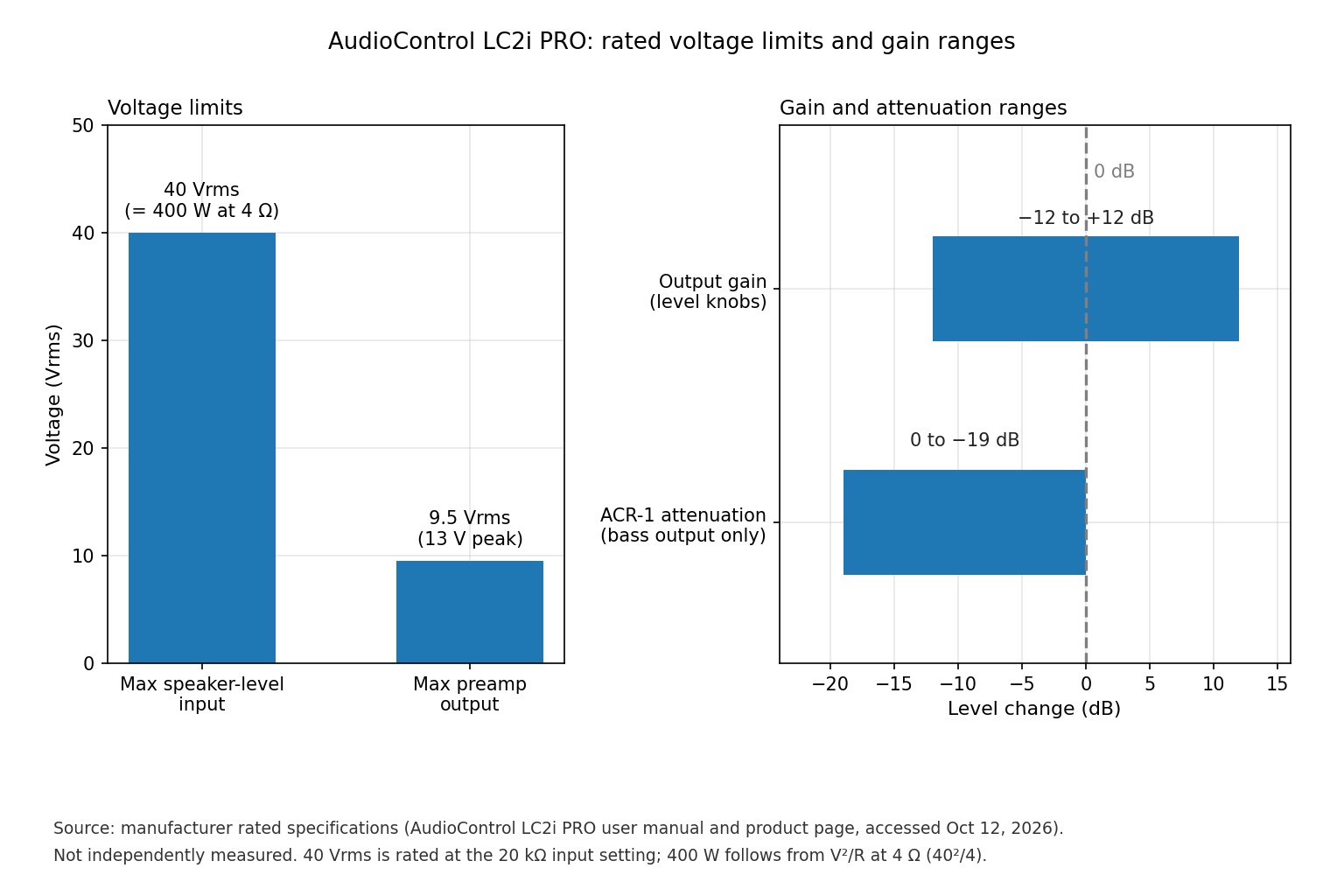
- Accepts up to 40 Vrms (400 W at 4 ohms) speaker-level input at the 20 kohm setting
- Load select switch (20 ohm, 60 ohm, 20 kohm) for factory amplifiers that need a speaker load
- Three turn-on methods: 12 V remote input, GTO DC-offset sensing or audio sensing
- Ground isolation switch (GND, ISO, 200 ohm) to help with buzz and alternator whine
- AccuBASS threshold and level controls to restore bass lost as factory volume rises
- ACR-1 dash bass-level knob and 20 ft cable included in the box
- Up to 9.5 Vrms output with plus or minus 12 dB gain range and a Maximized clip LED
Cons
- $169 is $50 more than the LC2i, which lists the same 9.5 Vrms output and 40 V class input
- Needs constant +12 V power and ground, so installation is a full wiring job
- Distortion and noise figures are published without test conditions and no independent lab measurements were found
- Input rating is stated only for the 20 kohm setting; limits for 20 ohm and 60 ohm are not confirmed
- Only two input channels, so systems needing channel summing point to larger models such as the LC7i
- Warranty length differs between sources: 1 year (product page), 5 years (2020 manual), 2 years (some retailers)
Specifications
| Current draw / fuse | 200 mA / 1 A recommended fuse |
|---|---|
| Dimensions / weight | 6.9 x 3 x 1 in with connectors / 0.75 lb (0.34 kg) |
| Frequency response | 20 Hz - 50 kHz, +/-1 dB (manufacturer; conditions not published) |
| Ground isolation | GND / ISO / 200 ohm switch (ships in ISO) |
| Input impedance (selectable) | 20 ohm, 60 ohm, 20 kohm |
| Max output level | 9.5 Vrms / 13 V peak |
| Output gain | +/-12 dB |
| Output impedance | 150 ohm |
| Outputs | Main (full range) 2 channels; Bass (1 kHz low-pass, variable) 2 channels |
| Remote | ACR-1 dash bass level control included (0 to -19 dB, bass output only) |
| Signal-to-noise ratio | Above 110 dB (manufacturer; conditions not published) |
| Speaker-level input | 2 channels, 40 Vrms / 400 W max (20 kohm setting) |
| THD | 0.01% (manufacturer; conditions not published) |
| Trigger modes | 12 V remote in, GTO signal sense (DC offset), audio sense |
| Type | Active 2-channel speaker-level to RCA line output converter |
Verdict
The LC2i PRO suits drivers who keep a factory stereo and want to add a subwoofer or amplifiers, especially where the factory amplifier needs a speaker load or ground noise is a risk. Its main strengths are 40 V input handling, 9.5 V output, three turn-on modes and an included dash bass knob. The compromises are a $50 premium over the LC2i, a full power and ground wiring job, and manufacturer-only performance figures because I found no independent measurements. At $169 it is reasonably priced for what it offers, but not a bargain.
The AudioControl LC2i PRO is an active line output converter (LOC). It sits between a factory radio or factory amplifier and any aftermarket amplifier you add, and converts the speaker-level signal into the RCA-level signal the amplifier expects. Is it worth buying? For a car with a factory stereo you plan to keep, where you want a subwoofer or extra amplifiers without replacing the radio, it is a well-equipped option. At $169 (verified on AudioControl's website on October 12, 2026) it adds load matching, ground isolation and three turn-on methods that the $119 LC2i does not list. If your factory system is simple, the LC2i or an even cheaper converter may be enough.
This page rates the unit 4.0 out of 5 using the rubric explained near the end. The verdict, pros, cons and full specification list appear in their own boxes on this page, so the text below focuses on how the unit works, what the evidence says and what to check before buying.
How this review was made
I have not bought, installed, listened to or measured the LC2i PRO. This is a specification and research review. It draws on AudioControl's product page and user manual, AudioControl's support article about load selection, product pages for competing converters, retailer listings, and owner comments on retailer and forum pages. Owner comments are anecdotal and are labeled that way.
I searched for independent laboratory measurements of this converter and found none from a source I could verify. One website describes oscilloscope testing of the unit, but I could not confirm its methods, so I do not rely on it. That means the distortion, noise and frequency-response numbers below are the manufacturer's claims, published without full test conditions. Where sources disagree, such as on warranty length, I say so.
Design and build
AudioControl lists the LC2i PRO at 6.9 by 3 by 1 inches including its connectors, with a weight of 0.75 lb (0.34 kg). It has integrated mounting brackets and comes with plug-in speaker and power connectors. The box contains the converter, the ACR-1 dash remote, a 20 ft cable for that remote, the connectors, a manual and warranty paperwork. AudioControl does not state the housing material in the sources I reviewed, so I make no claim about it.
The controls are a Main output level knob, a Bass output level knob, AccuBASS Threshold and Level knobs, and three switches for load selection, trigger mode and ground isolation. LEDs show power, AccuBASS activity and a Maximized indicator that warns when the unit's own output is clipping. That is a lot of adjustment for a small box, which is useful for fine-tuning but means setup deserves patience.
Features and usability
The LC2i PRO has two channels of speaker-level input and two pairs of RCA outputs. The Main pair is a full-range output with its own level knob. The Bass pair is low-passed at 1 kHz, has its own level knob, and is the output the ACR-1 remote controls. AudioControl rates the unit to accept up to 40 Vrms at the 20 kohm setting, which works out to 400 W into 4 ohms (40 x 40 / 4 = 400). Maximum output is 9.5 Vrms (13 V peak), with a gain range of plus or minus 12 dB.
Load selection
Many modern factory amplifiers check for a connected speaker and may mute or change their output if they see none. AudioControl says the LC2i PRO normally presents almost no load, so the load switch adds a speaker-like load to keep the factory amplifier passing audio. The positions are 20 ohm, 60 ohm and 20 kohm. According to AudioControl, 20 ohm suits late-model Dodge, Chrysler, Jeep, Ram and Fiat vehicles with a base system, 60 ohm suits the same brands with a separately amplified premium system, and 20 kohm suits everything else. The 40 V / 400 W rating is stated for the 20 kohm setting; I did not find input ratings for the other two positions, so treat those as not confirmed.
Turn-on, grounding and remote output
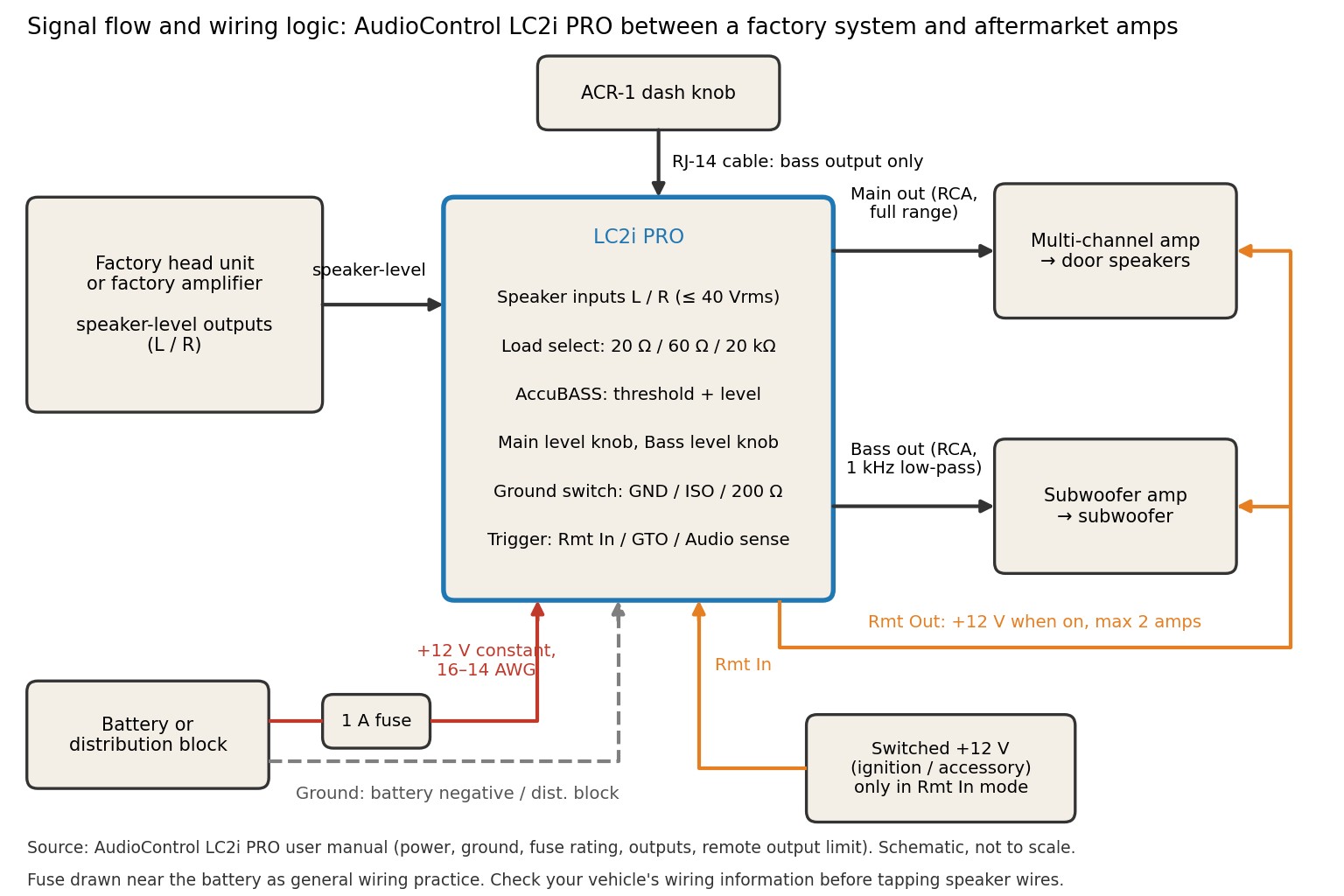
The unit always needs constant +12 V power and a ground, but it can switch on three ways: a 12 V remote input, GTO signal sensing (it detects the DC offset some factory systems output while the head unit is on), or audio sensing (it turns on only when audio plays). A three-position ground switch offers GND, ISO and 200 ohm settings to help with buzz or alternator whine; the unit ships in ISO. A remote output can switch on up to two amplifiers, and AudioControl warns that more than two may damage the unit.
AccuBASS and the ACR-1
AccuBASS is AudioControl's circuit for restoring bass that some factory systems remove as the volume goes up. Per the manual, you raise the head unit volume until the bass starts to fall away, then turn the Threshold knob until the status LED lights and bass returns, and finally trim the Level knob to taste. It can be defeated, or left on permanently. The included ACR-1 is a wired dash knob that controls only the Bass output as an attenuator, from 0 to minus 19 dB, and it cannot raise the level above the Bass Output Level knob setting.
Sound and performance
I did not listen to this unit, so this section is based on published figures and attributed reports. AudioControl lists a frequency response of 20 Hz to 50 kHz (plus or minus 1 dB), total harmonic distortion of 0.01% and a signal-to-noise ratio above 110 dB. It does not publish the test level, bandwidth or load setting behind the distortion and noise numbers in the material I reviewed. For comparison, the LC2i page lists 33 Hz to 100 kHz, so the PRO claims lower bass extension but a lower upper limit.
A converter cannot add content the factory source never supplied; it passes and reshapes what it receives. The practical benefit of a high output is gain structure: with up to 9.5 Vrms available, many installers can run amplifier gains lower, which is a common way to limit noise pickup. Output level of 9.5 V is 4.75 times a 2 V signal, or about 13.5 dB more (20 x log10(9.5 / 2)).
Owner reports are mixed in detail but mostly positive. AudioControl's own store shows 4.9 out of 5 from 7 reviews, a small sample on the manufacturer's site. On the critical side, one forum user traced a heartbeat-like noise to an LC2i PRO when RCAs were connected to the Bass output, which is the kind of problem the ground switch exists to address. A reviewer of the older LC2i reported noise in the mids and highs with AccuBASS active. These are individual anecdotes, not a measured failure rate.
Setup, installation and daily use
Following the manual, connect +12 V and ground to the battery or a distribution block with 16 to 14 AWG wire, protect the +12 V line with a 1 A fuse placed close to the battery, and mount the unit where it is protected from heat, moisture and dirt. Take care when drilling: avoid fuel lines, brake lines and existing wiring. Disconnecting the battery negative before wiring is standard practice. Connect left and right RCAs correctly, set Main and Bass levels, then set AccuBASS.
For level matching, AudioControl suggests setting the factory system to its maximum undistorted volume, then raising the LC2i PRO output toward your amplifier's input limit and backing off if the Maximized LED turns on. Keep volume sensible while setting levels; clipping can damage speakers, and sustained high volume can damage hearing. Many factory systems split frequencies across their outputs, so choose a full-range tap where one exists. One older LC2i owner found a subwoofer-only feed would not trigger GTO sensing until the volume was high, which a remote wire solves. Always check your vehicle's wiring information before cutting or tapping speaker wires.
After setup, daily use is simple: the factory volume control sets the overall level, and the ACR-1 adjusts the sub.
How it compares
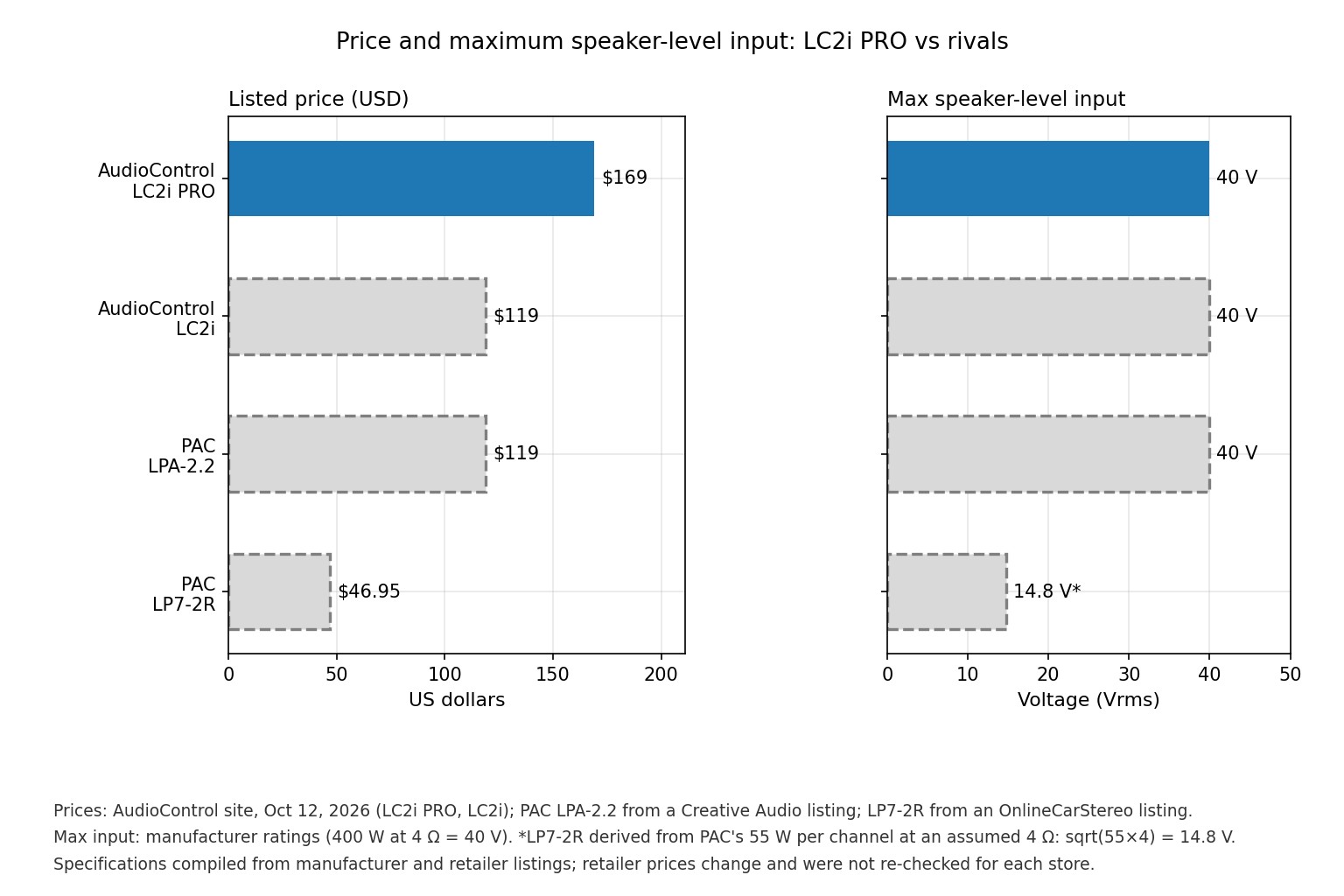
I compared the LC2i PRO with its sibling and two PAC converters, using manufacturer or retailer listings. Retailer prices change often, and I did not test any of these units.
| Feature | AudioControl LC2i PRO | AudioControl LC2i | PAC LPA-2.2 | PAC LP7-2R |
|---|---|---|---|---|
| Price (USD) | $169 (AudioControl, Oct 12, 2026) | $119 (AudioControl, Oct 12, 2026) | $119 (retailer listing seen in research) | $46.95 (retailer listing seen in research) |
| Max speaker-level input | 40 Vrms / 400 W (20 kohm setting) | 400 W per channel at 4 ohm | 40 V / 400 W at 20 kohm | 55 W per channel (PAC rating) |
| Max output | 9.5 Vrms | 9.5 Vrms | 9.5 V | Not confirmed |
| Load selection | 20 / 60 ohm, 20 kohm | None listed | 20 / 60 ohm, 20 kohm | None listed |
| Ground isolation | GND / ISO / 200 ohm | None listed | Common / ISO / 200 ohm | None listed |
| Turn-on | Remote in, GTO, audio sense | Remote in, GTO signal sense | Remote or DC offset | Signal-sensing remote turn-on |
| Remote level knob | ACR-1 included (bass output) | ACR-1 listed as included | LPA-REM sold separately | Included per retailer listing |
| Frequency response | 20 Hz to 50 kHz, +/-1 dB | 33 Hz to 100 kHz, +/-1 dB | Not confirmed for this model | 20 Hz to 20 kHz, +/-1.5 dB |
| THD / SNR | 0.01% / above 110 dB | 0.01% / above 110 dB | Not confirmed for this model | Not confirmed |
The LC2i is the closest alternative: the same output voltage and input rating for $50 less, but without load selection, a ground switch or audio-sense turn-on. Older retailer pages describe the ACR-1 as extra on the LC2i, while AudioControl's current page lists it as included, so confirm what the specific listing ships with. The PAC LPA-2.2 matches the PRO on input rating and load and ground options at a listed $119, but I could not confirm its frequency response or distortion figures, and its remote knob is optional. The PAC LP7-2R is far cheaper but has a much lower input rating and fewer features.
Who should buy it and who should skip it
It is a good fit for:
- Drivers keeping a factory radio who want to add a subwoofer or amplifiers.
- Cars with a factory amplifier that may need a speaker load, especially the Chrysler-family models AudioControl names.
- Installs where ground noise is a risk and a ground switch gives another option.
- Anyone who wants a dash-mounted bass knob in the box.
Consider skipping it if:
- You are replacing the radio with one that has RCA preouts; you do not need a converter.
- Your system needs more than two input channels or channel summing; AudioControl's six-channel LC7i is aimed at that.
- You want equalization, crossovers or time alignment; this is a converter, not a DSP.
- Your factory system is simple and budget matters more than extras; the LC2i or a cheaper converter may do.
Buying advice
Verify you are buying the PRO and not the plain LC2i; the names are similar. Check what ships: AudioControl lists the converter, ACR-1, 20 ft cable, connectors, manual and warranty paperwork. Check whether the unit is new or refurbished, since one retailer page I saw labeled its listing refurbished. Warranty information conflicts: AudioControl's product page says 1 year, the 2020 manual says 5 years and a retailer listing says 2 years, so get the terms in writing. AudioControl says it handles returns case by case with a return authorization number. Budget for power wire, a fuse holder, RCA cables and speaker-tap connectors if you do not already have them.
Final thoughts
The LC2i PRO earns a rating of 4.0 out of 5. The rubric weights performance and function at 40%, features and usability at 20%, build quality and design at 15% and value for the price at 25%. The features score is the highest because the load, trigger and ground options address real integration problems. Performance is held at 4.0 because the figures are the manufacturer's and I found no independent measurements. Build is 3.5 because the housing and construction are not confirmed in what I reviewed. Value is 3.5 because the $169 price is $50 above a sibling that shares the same output and input ratings. These scores are provisional and based on research only.
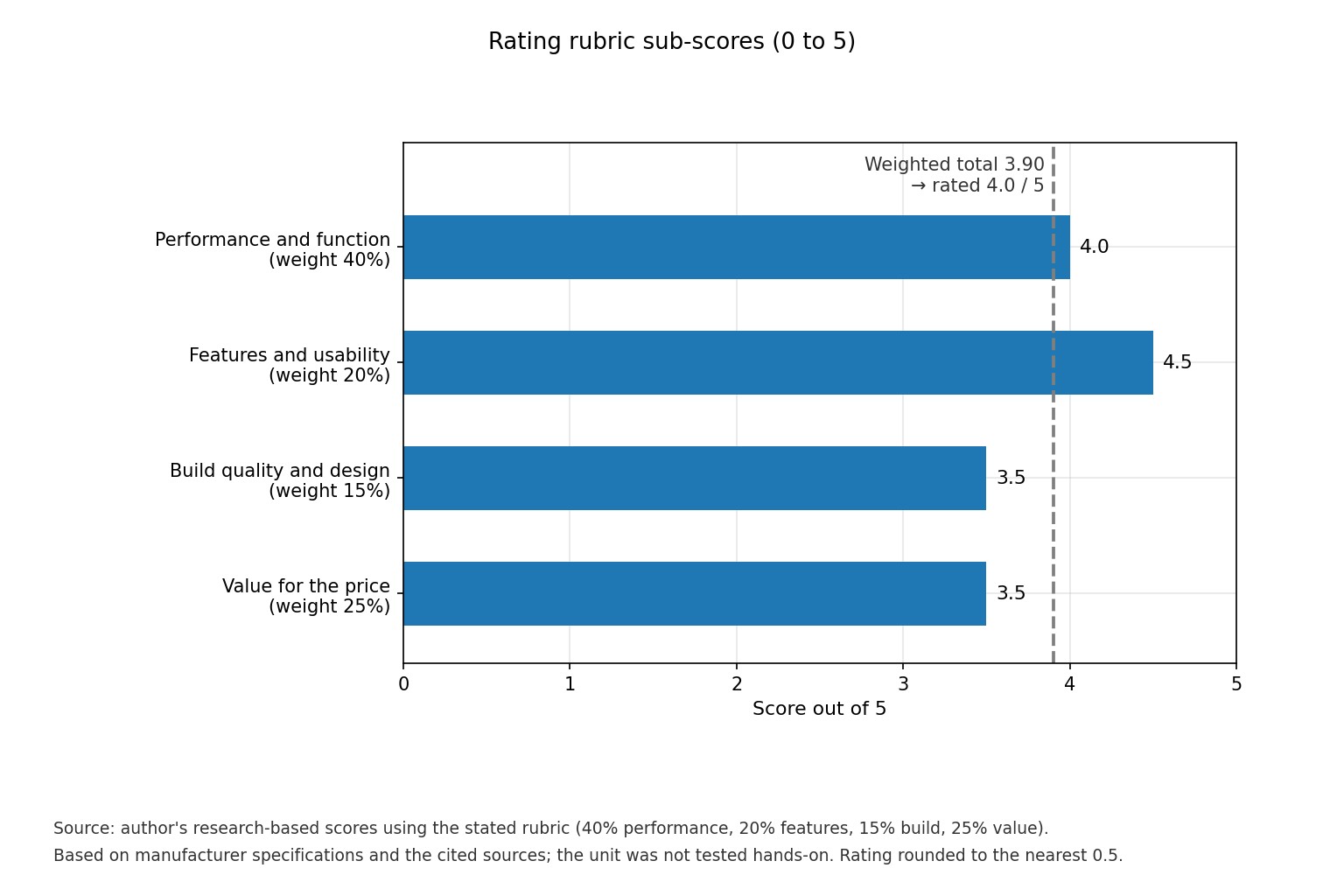
| Criterion | Weight | Score (0-5) | Weighted points |
|---|---|---|---|
| Performance and function | 40% | 4.0 | 1.600 |
| Features and usability | 20% | 4.5 | 0.900 |
| Build quality and design | 15% | 3.5 | 0.525 |
| Value for the price | 25% | 3.5 | 0.875 |
| Total | 100% | 3.90, rounded to 4.0 | 3.900 |
Some links on this page are affiliate links; they never affect our ratings.
Sources and further reading
- AudioControl LC2i PRO product page (price and specifications, accessed October 12, 2026)
- AudioControl LC2i PRO user manual
- AudioControl LC2i product page
- AudioControl support: load selection
- PAC announcement of the LocPRO Advanced series
- PAC LPA-2.2 retailer listing
- PAC LP7-2R retailer listing
- DIYMA forum thread on engine noise (anecdotal)
AudioControl LC2i PRO FAQ
What is the difference between the AudioControl LC2i and LC2i PRO?
AudioControl's spec pages show the PRO adding a three-position load selection switch (20 ohm, 60 ohm, 20 kohm), a ground isolation switch and an audio-sense turn-on mode. Both list 9.5 Vrms maximum output, and the current LC2i page also lists an ACR-1 remote. AudioControl lists the LC2i at $119 and the PRO at $169 as of October 12, 2026.
What do the 20 ohm, 60 ohm and 20 kohm settings do?
They change the load the converter presents to the factory source. AudioControl says the 20 kohm setting presents essentially no load, which can make some factory amplifiers stop passing audio. It recommends 20 ohm for late-model Dodge, Chrysler, Jeep, Ram and Fiat vehicles with a base system, 60 ohm for those with a separate premium amplifier, and 20 kohm for everything else.
Does the LC2i PRO need a remote turn-on wire?
Not always. It can switch on from a 12 V remote input, from DC-offset (GTO) sensing or when it detects audio, but it still needs constant 12 V power and a ground. One owner of the older LC2i reported that a subwoofer-only factory feed did not trigger GTO sensing until the volume was high. In that situation a remote wire is the dependable choice.
Can I use it with a factory amplified system?
Yes, that is the situation the load selection switch is meant for, but the right setting depends on the vehicle. Tap the outputs your car's wiring information recommends, follow AudioControl's setting guidance, and keep the signal within 40 Vrms. If the factory system mutes or behaves oddly after you connect the unit, revisit the load setting first.
Does the ACR-1 remote control my whole system?
No. AudioControl says the ACR-1 controls only the Bass Output and acts purely as an attenuator, from 0 to minus 19 dB. It cannot raise the level above where the Bass Output Level knob is set, so set that knob for the loudest level you want first.
Is the LC2i PRO worth $169 compared with a $47 converter like the PAC LP7-2R?
It depends on your car. PAC rates the LP7-2R for 55 W per channel input with a 20 Hz to 20 kHz (+/-1.5 dB) response and lists no load selection or ground switch, while the LC2i PRO accepts up to 40 Vrms and adds those features. I have not tested either, so I cannot compare their sound. If your factory output is high voltage or the system is fussy, the extra input range and settings are the reason to pay more.
How many amplifiers can the remote output turn on?
AudioControl says to connect no more than two amplifiers to the LC2i PRO remote output, because more than two may damage the unit. With more amplifiers than that, a relay is a common approach. Check your amplifiers' remote draw before wiring.
What warranty does the LC2i PRO have?
Sources disagree. AudioControl's current product page lists a 1-year manufacturer warranty, the 2020 user manual lists 5 years, and at least one retailer lists 2 years. Ask the seller to confirm the warranty terms in writing and keep your receipt.